
Quilt No.1042JB - Joan Berger
Description:
Hand sewn frame quilt featuring appliqué. There is a centre square surrounded by two wide borders. The design consists of a large basket in each corner of the square with leaves and buds scattered at random. The 2 borders have flowers and leaves and the outer wide border has a small basket in each side. Colours are pale and strong pinks, blues shading to indigo, browns-beiges and dusty red. The centres of the flowers are all reverse appliqué. There are signs that there has been a backing but it is now one layer. 2700 x 2700 mm.
History:
The quilt was made in England almost certainly by Anne Elizabeth Hirst, known as 'Granny Hirst'. She came to Western Australia in the 1920s and died in 1928 aged 71. The quilt passed to Rosa Hirst her daughter and then to the present owner Joan Berger, grand-daughter of the maker. It is not used.
Story:
Granny' Hirst was born in England and lived in Scarborough. She joined her son at Boyup Brook WA in the early 20s. Mrs. Hirst enjoyed various forms of sewing and craft including smocking, cross stitch and crochet. She made a crochet cover for a cabin truck.
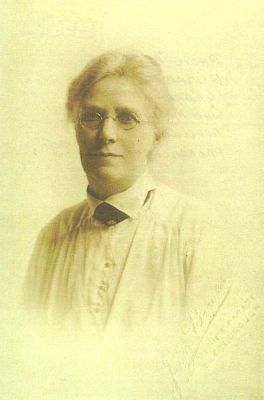
Anne Elizabeth Hirst (Granny Hirst)c.1900
Related Quilts:
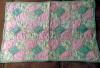
Patchwork quilt made for a doll's bed or possibly as an infant's quilt. All cotton. The owner calls the pattern a variation of 'Bow Ties'. Hand sewn and quilted. This quilt is new.
534 x 382mm
534 x 382mm
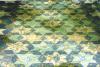
Hand sewn patchwork quilt with a pattern of blue stars. Each star consists of hexagons in the centre with part diamonds forming the star shape. The quilt is made from scraps. It is not padded and the backing is cotton and has a hexagon star border. 2660 x 2470 mm
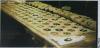
Hand sewn quilt comprising 263 rosettes of hexagons in chintz. 6 hexagons around a centre one form a rosette. Between these are plain off white hexagons. There is a mark on one corner on cream material, possibly a stamp. The crochet lace border is on three sides only.
2850 x 2720mm
2850 x 2720mm

Cotton patchwork quilt in an all over pattern of diamonds in a wide variety of patterned and plain materials. Many seams are oversewn in feather stitch which goes through to the backing of calico.
1625 x 925mm
1625 x 925mm
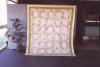
Pieced repeat block, in what the owner calls 'Our Village Green' pattern. Wide variety of patterned and plain materials. Finely quilted. Padding is cotton and the backing is white calico. 2180 x 1890 mm.
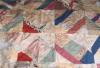
This quilt consists of rows of pieced blocks approximately 280mm square sewn directly on to a foundation square. The design is really a version of 'log cabin' set on the diagonal. The backing squares are made from flour bags including a number stamped in blue ink "The Defiance Milling Company��..Toowoomba NET 3 lbs". Another is stamped in green ink "Parsons Rolled Oats". Two short sides and one long side of the quilt are bound in apricot coloured cotton.
1960 x 1700mm
1960 x 1700mm