
Quilt No.1093RD - Rhona Dunwoodie
Owner:
Rhona Dunwoodie
Location:
WA Metro
Maker
Maker:
Unknown
Made in
ENGLAND
Patterms
Date:
1881 - 1900
Description:
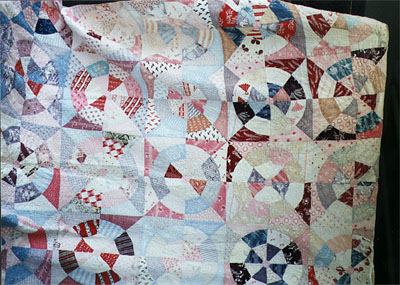
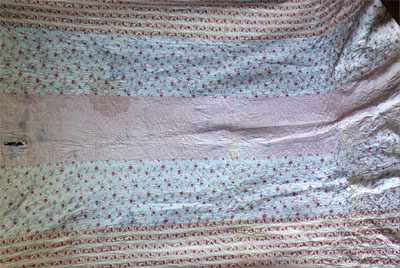
Block pattern consisting of a circle, hexagon and circle within a square. Cotton dressmaking fabrics with a few plain creams. Hand pieced and hand quilted. At some stage has been machine reinforced. Now faded, worn and damaged especially one end. Quilting pattern is four leaf clover inside large cable. The backing is 4 different pink toned fabrics in longitudinal stripes. Cotton batting. 2620 x 2300mm
History:
The maker is unknown but it was made in the north of England in the Durham area and was owned by the present owner's mother. It was brought to Perth WA in 1992. It is not used now.
Story:
"This quilt unfortunately was not appreciated. During the time a prize bull was sick it was removed from my brother's bed to keep it warm until the vet arrived. At that stage it was in perfect condition. This was at Myton House Farm Ingleby, Barwick. At this stage it was still in perfect condition (early 1951). 20 years later it was used as packing when the farm was transferred to Northallerton Yorkshire. It was then transported to Perth Scotland with some cattle. From Perth Scotland it was brought to Perth Western Australia in 1992." [Rhona Dunwoodie WA]
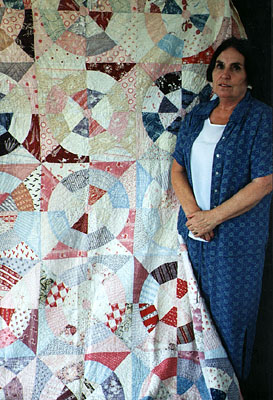
Rhona Dunwoodie with her mother's quilt.
Related Quilts:
Quilt of hand stitched cotton hexagon patches, the hexagons are in groups of 7 to form flowers, with white or cream 'paths'. The quilt centre has 19 flowers grouped within a single hexagon border of brown and red patches. In each corner of the quilt there are 6 flowers grouped around a larger flower within a single border of darker print hexagon patches. Backing is cream cotton, machine stitched to the top. There is no padding or quilting. Some fabric patches have deteriorated.
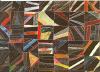
Hand pieced crazy quilt in a variety of plain coloured velvets. All seams are over embroidered in a variety of stitches. There is no padding and the backing is heavy black cotton. 1900 x 1630mm.
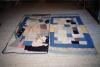
Irregularly patched from a variety of cotton dress prints, checks, plains and mattress ticking. 1920s and 30s fabrics. Both top and back are similar. Hessian padding. Originally two single quilts, now stitched together.
1850 x 1720mm
1850 x 1720mm
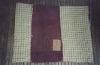
Utilitarian quilt made from large pieces of wool, flannel and cotton. Machine construction and the padding is wool.
1570 x 152Omm
1570 x 152Omm
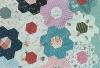
Hand sewn hexagons over paper templates in a pattern known as 'Grandmother's Flower Garden'. Materials are printed dress cottons, patterned and plain, mainly in pinks, blues and browns. The border and backing is grey linen and is machine stitched on. There is no padding. 2060 x 1579 mm.
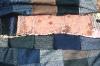
Double sided utility quilt made from machine pieced squares of tailors' samples and men's and boy's suitings. The padding is 5 or 6 layers of pieced used clothing including darned, threadbare socks, part jumpers, blanket pieces etc.
2090 x 1340mm
2090 x 1340mm