Quilt No.194FW - Fred Wood

Fred Wood
Owner: 
Fred Wood
Location: 
VIC North East
Maker
Maker: 
Charlotte Gambold
Made in
AUSTRALIA VIC
Date: 
1901 - 1920
Description: 
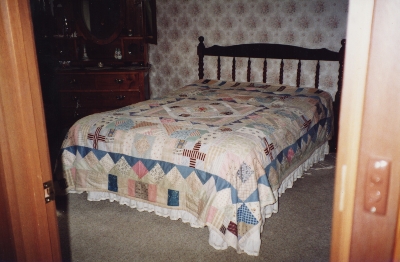
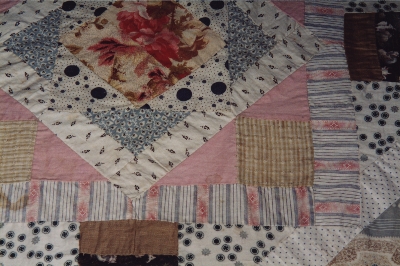
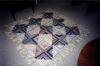
Patchwork quilt made from a variety of printed cottons over 70 prints, using shirting and dress fabrics, fabrics also from pyjamas, curtains, aprons, tablecloths. The centre medallion is a square within a square with white borders, the inner frame made of sawtooth triangles. This is surrounded by pieced triangles, square within a square and crosses. Outer frame of sawtooth triangles, and outer border pieced of squares and triangles. Colours are pinks, blues, burgundy and pastels, with floral, stripe and check prints. Lining of cotton. Backed with a printed cotton. Quilt is bound on all edges.
...
History: 

Made by Charlotte Gambold, c.1900. Previously owned by Mrs Vera Banning, daughter of Charlotte Gambold's sister Elizabeth Bennett. Owned by Charlotte's grand nephew, nephew of Vera Banning.

Story: 

"Charlotte Gambold arrived in the Wangaratta district at about 6 years of age, the eldest of three children, with her parents, Thorres and Mary Gambold, in 1866. Later, her father was a molybdenite miner (this mineral was, and still is, used in the hardening of steel).
When her sister Elizabeth married Mr AH Bennett of 'Highfield', Evarton Upper, Victoria, in 1893 we can only surmise that Charlotte planned a medallion quilt for the happy couple. When it was actually commenced, and when it was finally completed is lost in history, but the quilt has remained in the family throughout its existence. Whether Charlotte designed it from scratch or had seen one of this type of quilt is also lost to us unfortunately. ...
This marvellous Australian quilt is in the possession of a grand nephew of Milawa Victoria, and is in very good condition. He inherited it from his aunt, Mrs Vera Banning, who died in 1994, aged 94. Vera inherited it from her mother, Elizabeth, the 1893 bride, about 1954, when she lived in Cusack Street, Wangaratta. Charlotte died in t he 1950s, and is buried in the Bowman's Forest cemetery, on the Wangaratta/Myrtleford Road.
Charlotte's grand nephew and his brother, both had quilts made for them by their Aunt Charlotte and they remembered seeing this quilt when they were young boys and then forgetting all about it. Their own quilts have long worn out and no longer exist� Their cousin, George Bennett, had one given to him by his mother when he was eight or nine. These quilts were made out of ties and bits of men's materials, and were warm and practical for the boys' sleepout.
Mrs Joan Wood, Milawa, thinks Charlotte made many quilts and had a little business of quiltmaking, as she was a maiden lady, and liked to keep herself occupied."
[From article by Brenda Leitch, 1995, in 'Down Under Quilts', Spring 1995, p.20]

Related Quilts:
Muriel Thompson
Quilt in pattern known as 'double weeding ring'. All cotton, using old prints, plaids, checks and solid colours, with plain blues and red squares at the intersections of the circles. White background. Hand pieced. Padding is Hobbs Heirloom: cotton 80%, polyester 20%. Backing is cream quilted cotton. 2500 x 2100 mm.
Wangaratta Historical Society
9 large blocks of crazy patchwork in silks and velvets. The blocks are divided by strips of deep ruby coloured silk. There is a wide ruby border with peaks to which is attached cream lace. The backing is beige silk. The main blocks are outlined with feather stitch in gold thread and many individual patches are outlined in fancy stitches and have embroidered motifs some of which are Australian eg centre patch has Sturt's Desert Pea flowers, parrots, wattle. There are also English flowers, Japanese motifs, flags, domestic objects and Marianne's initials. Embroidery is in a variety of threads including chenille.
2250 x 2180mm
National Gallery of Australia
" Reversible patchwork quilt of woollen suiting/upholstery fabrics in khaki, greys, blues and browns. Both sides have different designs. The front of the quilt has 13 rows of 12 vertical rectangles flanked on either side by a column of 22 horizontal rectangles. The reverse has a more interesting and complex design of small and very large rectangles, squares and triangles; with khaki contrasting with the duller greys and blues. The patchwork layers are joined at the edges with machine stitching and the quilt is machine quilted along 3 horizontal lines following joins in the patchwork; therefore not being totally straight. These lines are more noticeable on the reverse. The reverse face has been on display at the NGA." [NGA] There is a cotton blanket used as padding. 2054 x 1451mm
Glenda Wilkinson
Small quilt made from pieces of heavy weight wooollen coat material cut into strips and machined together. It is reversible. Each side is made from different materials but in similar colours of aqua, blue, green and beige. The 2 layers are quilted together with a few machined lines of straight stitching. It has a folded and machine stitched edge. There is no padding.
950 x 790mm
Phyllis Dowling
Hand pieced cot quilt made from small rectangular shapes of a great variety of materials including cottons, silks, wools and velvets. The backing is cotton sateen in 3 colours and is brought to the front to form a border of pink, cream and yellow.
1170 x 920mm
The Pioneer Women's Hut
Patchwork top with a centre frame of a mauve cross outlined in black within a square bordered with pink. The rest of the top is rectangles and squares in a wide variety of materials. There is no padding. The backing is brown, possibly curtain material.
1910 x 1480mm