
Quilt No.264NTA - National Trust of Australia (SA)


Owner:
National Trust of Australia (SA)
Location:
SA Country
Maker
Maker:
Mrs Charles Warren
Made in
unknown
Patterms
Date:
1851 - 1880
Description:
Patchwork quilt of hexagons in silks and velvet, the velvet in plain colours, the silk in plains, stripes, checks and brocades. Centre is made from red brocade hexagons with black silk patches embroided with a variety of flowers and leaves. Stitched to a red velvet border, then top and bottom have Australian motif of crossed wattle branches embroidered in bobble stitch, and on the sides embroidered red flowers. The rest of the quilt is made of hexagons, the edge stitched to a brown silk border, then a border of triangles and a striped edging. Surface embroidery. Crepe backing. Some newspaper...
History:
Made by Mrs Charles Warren, around 1869, the date on newspaper used as templates for the patches. Owned by the National Trust of Australia (SA), Renmark. It is displayed at the historic house museum 'Olivewood'.
Related Quilts:
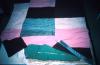
The top is machine pieced patches of used clothing. The backing is large pieces of dress materials and either end patches similar to the top. The padding is a chaff bag or similar with patches of worn, matted children's jumpers sewn directly on to it.
1400 x 1150mm
1400 x 1150mm
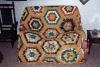
Patchwork quilt of cotton hexagon patches grouped in 'flowers', comprising 4 rings of patches around a central hexagon. Prints and plains are used, the colours mainly browns, greens, yellows, dark blue and dark pink. The 'paths' are in a yellow-brown cotton. Cotton backing. The padding is probably an old blanket. The quilt is an irregular shape, and is tied.
2550 x 1870mm
2550 x 1870mm

Hand stitched silk quilt in mosaic patchwork based on triangles. Pieces include dress materials and some embroidered linings fom men's waist coats. Paper templates. The backing is cotton.
2200 x 2000mm
2200 x 2000mm
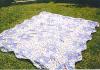
The centre of the quilt is a small blue 6 pointed star surrounded by a larger blue star. Blue stars also form a border to the quilt. The background material is a multicoloured small floral pattern on white cotton. The quilt is all hand worked over templates. The padding is cotton and the backing is polyester sheeting with a border of stars.
2650 x 2475 mm
2650 x 2475 mm
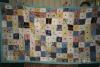
Patchwork quilt made from squares of cotton prints in florals, stripes, spots and checks, joined together in rows. Colours are predominantly blues, reds, yellow and pastels. Binding is of turquoise blue fabric. Materials appear to be from the 40s or 50s. Patches caught in the middle with a woollen knot - red, yellow, blue wool. No quilting. Backed in blue fleecy flannel.
Single bed length and width.
Single bed length and width.
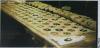
Hand sewn quilt comprising 263 rosettes of hexagons in chintz. 6 hexagons around a centre one form a rosette. Between these are plain off white hexagons. There is a mark on one corner on cream material, possibly a stamp. The crochet lace border is on three sides only.
2850 x 2720mm
2850 x 2720mm