Quilt No.312JL - Joyce Lacey

Joyce Lacey
Owner: 
Joyce Lacey
Location: 
QLD South West
Maker
Maker: 
Ivy Campbell
Made in
AUSTRALIA QLD
Date: 
Unknown
Description: 
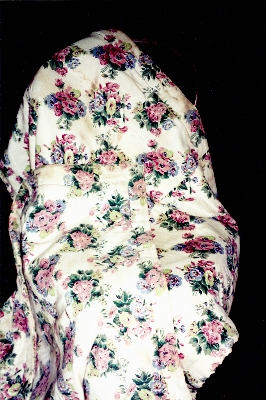
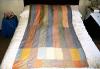
Wholecloth utility quilt covered with good quality cotton printed with posies of pink, blue and green flowers and leaves, the top side has darker colours than the reverse. Filling is made from old blanket pieces, cardigans and pullovers stitched to an old blanket. Top and back machine stitched together.
1601 x 991mm
History: 

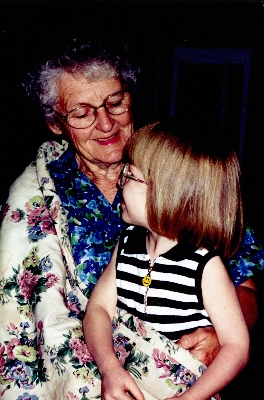
Made by Ivy Campbell (born Castle, 1901-1957), in the Lockyer Valley (Qld), and owned by her daughter, Joyce Lacey. Called the 'wagga' or the 'wagga rug'.

Story: 

The quilt has been used for moving furniture and sent to Scout camp with Joyce's son Graham when he was younger.
"My mother Ivy taught herself to sew on a Singer treadle machine. She was a very good sewer, crocheter, & knitter. Lockyer, on the main line between Brisbane & Toowoomba, was a railway workers community. Ivy would do dressmaking for neighbours & charge 2/6 a dress!'
Ivy Campbell's parents were Charles & Ada Castle. The 5 children were, Reg b.1914, Ruby b.1899 never married, Amy b.1909, Ivy b.1902, Harry b.1905
[In the photo]: Ivy's dress would have been made by her, also the collar. Amy bought her dress from a Sydney outfitters catalogue. Amy made Ruby's dress - also my grandmothers, Ivy's mother's dress.- although my grandmother was quite capable of making dresses in her old age & she may have made both her own & Ruby's dresses.
If Amy made her a dress that she (Grandmother) regarded as being too large, she would unpick some of it and take it in when Amy was away for a day. Her dress (grandmother's) in the photo does look a good fit.
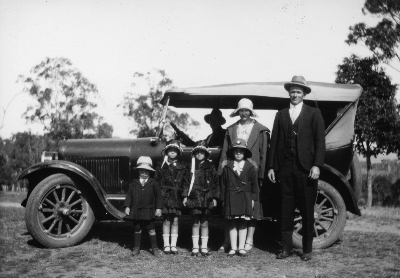
[In the other photo] Eric Campbell, Ivy Campbell (nee Castle) and their 4 children,Joyce b.1924, twins Joan and Jean b.1926, Keith b.1928.
Ivy's brother Harry was in the car (bought new in 1926 a BUICK I think). He was taking us from the CASTLE farm to the Railway Station at CROWS NEST (nth of Toowoomba) for our return to Toowoomba & then another train to where we lived down the range at LOCKYER railway siding."
[Joyce Lacey 1998]
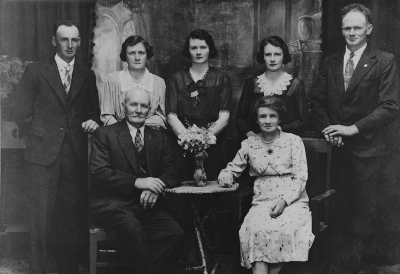
Charles & Ada Castle, Reg, Ruby, Amy, Ivy, Harry
Eric & Ivy Campbell, Joyce, Joan & Jean, Keith

Related Quilts:

Yvonne Hamdorf
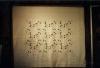
Wholecloth pram quilt with a top of pink cotton sateen, and the reverse is a more finely woven, ivory, fabric. All over quilting design as main feature, with stylised hearts, leaves and cross hatching. The padding is cotton batting. 870 x 660 mm.
John Tomkin
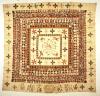
Hand stitched, cotton, appliquéd, quilt in a flower pattern on a plain background. Colours are shades of green, apricot and browns. This quilt was known as a 'Bride's Quilt'. Padding is thought to be layers of white fabric raised almost like a wadding. The backing is cotton material. 2470 x 2020 mm.
Powerhouse Museum
"A tied patchwork wagga quilt made from swatches of men's wool suiting fabrics in blue/grey and pink/brown tonings. Rectangular swatches have been cut in half diagonally, and the resulting right-angled triangles paired to form larger equilateral triangles which alternate dark with light across the field. The quilt has been machine and hand pieced, then machined in vertical stripes.
The centre field is bounded by two strip-pieced borders at top and bottom, and three down each side. These are sewn from rectangles, using light pink/brown tones for the inner border and darker colours for the outer borders. The quilt is padded and backed and the side seams are secured with black herringbone stitch. The three layers are tied together invisibly with lazy daisy stitches in black cotton from the back." [PHM] The padding is a wool blanket and the backing is two pieces of cream twill cotton.
2030 x 1440mm
National Gallery of Australia
" Reversible patchwork quilt of woollen suiting in grey, blue, navy, maroon and brown. The fabrics appear to be new tailor's sample pieces (the sizing is still present on the fabric, signifying it has never been washed). The patches are rectangular and vary in size. Both sides have different designs. The front of the quilt has 4 rows of 12 vertical rectangles then below this are 4 rows of 7 horizontal rectangles followed below by 4 rows of 11 vertical rectangles. The reverse of the quilt has a section at the top and bottom composed of 5 rows of 9 horizontal rectangles. The central area is made up of a centre section of 6 rows of 5 vertical rectangles; flanked on either side by a column of 10 horizontal rectangles and two columns of 8 smaller vertical rectangles.
The patchwork layers are joined at the edges with machine stitching. The patchwork layers and padding are machine quilted on the front down 2 vertical lines following joins in the patchwork; therefore not being totally straight. The lines are more noticeable on the reverse as the 2 sides do not match. The front face is displayed at the NGA.
Between the patchwork layers is a striped cotton blanket in black, sky blue, white and cream." [NGA]
2082 x 1386mm
Margaret Wilson
Hand stitched appliqued quilt or banner. Different hand stitching indicates applique was probably done by several people. There is no padding. The backing is calico.
2230 x 2140mm
Joan McGregor
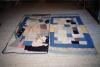
One side of this quilt is large pieces of check and striped material surrounding a small patterned supper cloth with a border of scrap pieces. The other side is small, floral, check, spotted, striped and plain cotton pieces surrounding a tablecloth. It is machine sewn and is not quilted. The padding is an old woollen blanket.
1825 x 1625mm