
Quilt No.393CC - Cressida Mary Webb Challis
Owner:
Cressida Mary Webb Challis
Location:
NSW Sydney
Maker
Maker:
Isabel and Jean Portus
Made in
AUSTRALIA NSW
Patterms
Date:
1941 - 1970
Description:
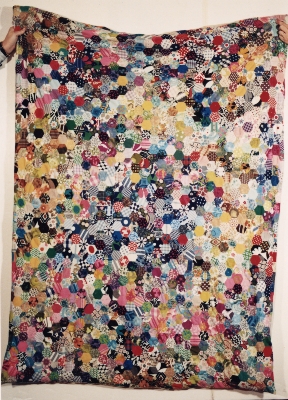
Quilt of 50mm hexagons in random pattern. Hexagons are made from scraps of old materials with many variations of colours and patterns. One red print hexagon has "J.P." on it. The padding is an old eiderdown and the backing is calico.
1660 x 1220mm
1660 x 1220mm
History:
The quilt was made by twin sisters Isabel and Jean Portus in Sydney. It was commenced in the 1960s and completed in the 1970s. It is now owned by family member Cressida Challis and is used on the spare bed in her home.
Story:
Isabel and Jean, who made the quilt, were twin sisters. They never married. Isabel, Jean and another sister Barbara all used brass templates to make their hexagon papers. The templates were made by Barbara's husband Serge who was a fitter and turner. The papers were often cut from shareholders' annual reports and were reused a couple of times.
Isabel and Jean made many patchwork articles, made their own clothes, crocheted and knitted socks during the war.
Related Quilts:
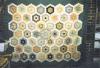
Hexagon rosettes of printed and plain cotton in a flower pattern. Incomplete, top layer only.
2439 x 1981mm
2439 x 1981mm

Patchwork quilt made from brightly coloured printed cotton fabrics in hexagon patches hand sewn together in rosettes, and stitched by machine onto a border of green moire taffeta. No padding. Backing is green cotton satin curtain lining. There is a matching pillow sham.
2591 x 2540mm
2591 x 2540mm
Quilt top of hexagons in silks and satins, pieced over papers in the English tradition. Some paper templates still in place. One states: 'Semi - Monthly Regular Clipper packets to New Zealand, Port Phillip, Sydney�2nd of each month..Adelaide' suggesting it may have been from a shipping timetable.
1580 x 1830mm
1580 x 1830mm
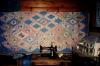
Quilt of 2025 hexagons stitched together to form diamond patterns. Hand sewn using paper templates. Materials are cottons and plains typical of the thirties period. The backing is blue cotton and the quilt is bound with many rows of coloured bias binding through which is treaded window cord. There is no padding. The quilt is called 'Grandmothers' Flower Garden quilt'.
2439 x 1829mm
2439 x 1829mm
Log Cabin quilt featuring centre square and 3 outer borders. Evidence of later repairs and additions by machine and hand sewing. There is white paint on it. The log cabin pieces are sewn on to black netting. There is no padding and the backing is a centre piece of gold damask/sateen and green and black sateen borders.
1728 x 1321mm
1728 x 1321mm
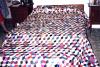
Tumbling Block quilt made from pure silk ribbons, patterned and plain. The quilt edge follows the block shapes. The backing is polished cotton printed with flowers.
2743 x 2439mm
2743 x 2439mm