
Quilt No.528DT - Di Tement
Owner:
Di Tement
Location:
TAS Hobart
Maker
Maker:
Unknown
Made in
Unknown
Date:
1881 - 1900
Description:
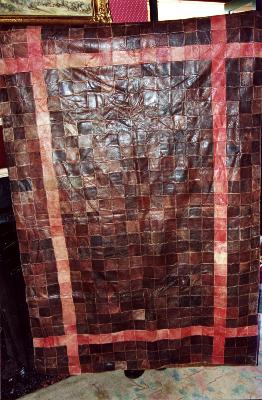
Leather buggy rug constructed from hundreds of squares each 60mm. There is a pink band of the same size squares 3 rows in from each border. There is no padding. The backing is a towelling type material.
1140 x 1700mm
History:
This buggy rug is part of the 'Adam Tement Collection'. Adam Tement 1962-1990 lived in Launceston and was a serious collector of Australian pottery of which he had a very fine national collection. He later "fell in love with quilts" [Di Tement]. Adam died of cystic fibrosis and the quilts are now owned by his mother Di.
Related Quilts:
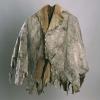
Kangaroo skin cloak of seven gores is made from the skins of seven grey kangaroos (Macropus fuliginosus). The skins vary in size and shape, the inner five are roughly triangular. The cloak is edged with a series of loops, through one of these near the collar is a piece of cloth which appears to have tied the cloak together. The skins are sewn together with two sorts of linen or cotton thread. In a small diamond-shaped gusset at the back of the neck there are some stitches of sinew. The skins are sewn together by means of a small hem which was turned back on to the fur, so stitches went through two layers of skin on each gore. There are some small holes in the skins. The skins are very soft and pliable, and greyish in colour; they vary in size and shape.
Longest part: 800mm
Ref: MA Thesis 1973, S.Meagher 'A Reconstruction of the Traditional Life of the Aborigines of the S.W. of Western Australia.
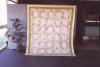
Pieced repeat block, in what the owner calls 'Our Village Green' pattern. Wide variety of patterned and plain materials. Finely quilted. Padding is cotton and the backing is white calico. 2180 x 1890 mm.
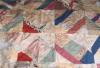
This quilt consists of rows of pieced blocks approximately 280mm square sewn directly on to a foundation square. The design is really a version of 'log cabin' set on the diagonal. The backing squares are made from flour bags including a number stamped in blue ink "The Defiance Milling Company��..Toowoomba NET 3 lbs". Another is stamped in green ink "Parsons Rolled Oats". Two short sides and one long side of the quilt are bound in apricot coloured cotton.
1960 x 1700mm
1960 x 1700mm
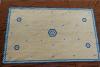
Patchwork quilt made of 1 inch hand paper pieced hexagonal patches (English technique), with plain and floral patterned blue fabrics in clusters at regular intervals throughout the taupe coloured patches. Centre of quilt has a cluster or 'flower' of 4 rings of patches, the centre group embroidered in blue satin stitch: 'MW 1938'. Border consists of 3 rows of medium, light and dark blue hexagons. No padding. Backing is of blue cotton sateen.
2185 x 1372mm
2185 x 1372mm
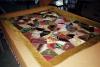
Crazy patchwork quilt made from pieces of silk, velvet, silk ribbon and brocade in a variety of patterns and plains, in a range of colours. All patches are edged with embroidery, in blanket, feather, herringbone and other stitch variations. Many patches are embroidered with flowers, butterflies, leaves and initials of family members, and there is some beading. 1901 is embroidered in one corner. Quilt has a wide border of gold velvet. Patches are stitched to a base fabric. Backing is dark green sateen.
1470 x 1060mm
1470 x 1060mm
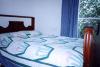
Hand made cotton quilt in repeat block with appliqued Iris pattern. It is a kit quilt. "The Iris, Design "R" of the 'Mountain Mist Series' of Quilt Patterns" from The Stearns & Foster Company, Lockland, Cincinnati, Ohio. Copyright 1930. The backing is cotton and the filling also.
2439 x 1981mm
2439 x 1981mm