Quilt No.60MC - Mare Carter

Mare Carter
Owner: 
Mare Carter
Location: 
NSW South East
Maker
Maker: 
Eva Leota Towe
Made in
USA
Date: 
1921 - 1940
Description: 
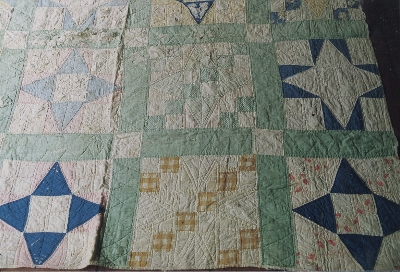
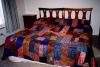
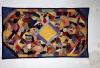
Patchwork quilt of pieced repeat blocks in cotton in white, blue, green, orange and red prints, plains and checks. Blocks are set between green sashes with white corner blocks. The pattern is 'Saw Tooth Star' or 'Jacob's Ladder' variation. Backing is of cotton, padding of cotton. Hand sewn and hand quilted.
2058 x 1296mm
History: 

Made by Eva Leota Towe, in southern California, USA Mare Carter[Mary] grand-daughter of Eva and present owner of the quilt, was born in California in 1930 and moved to Australia in 1950. "Grandmother passed away in 1953. In 1960 my Mother brought me Grandmother's legacy, her hand-works including the quilts. They were used frequently as family quilts for many years and now occasionally". Mare has registered a collection of 15 of her grandmother's quilts.

Story: 

"VINTAGE QUILTS 1898-1938
These quilts were made by my grandmother, Eva Leota Towe. Her maiden name was Tussey and she came from Missouri, U.S.A. In early 1900 grandmother moved to Washington State and later to Southern California.
Patchwork was our family tradition. It provided a frugal means to "dress" a home and to make cosy beds which were also pretty. I rarely saw grandmother without her bag of patches and templates handy, rarely saw her sitting idle; usually while chatting or listening to the radio, she'd be quietly piecing together patches which were cut mostly from used garments. Her scissors were kept sharp by my grandfather, she wore out countless thimbles, her needles were regularly pushed in and out of a little sock of sand to ginger up their points. The actual quilting was often done in company with friends who belonged to the Rebecca Lodge. At least one of these quilts is a Friendship Quilt made and signed by those women in 1933.
Grandmother also embroidered, to decorate her tables, her aprons and also her tea-towels which were always made from bleached flour sacks. It embarrassed my Mother and her sister that their underclothes were made from the same materials. Maybe this is why sewing and handcrafts skipped a generation in my family. The contribution my mother made was to keep these things safe and gradually pass them along to me.
My children suffered from allergies. Wool was too itchy, and too hot. The cotton quilts of my grandmother were perfect for our beds here in Australia. Thus we used our legacy to good purpose. Sadly, most of the quilts are now tattered and worn, but much loved for that, and for the affection which she sewed into them. She never made things to be preserved as objects of art. They represent her creativity, her duty as a woman and a home-maker, and her principle means of recreation and sociability."
[Mare Carter, Foxground 1998]
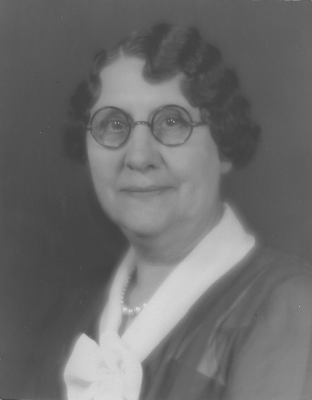
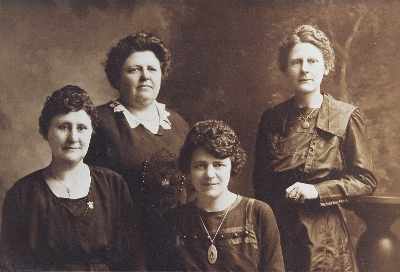
Eva Leota Towe c 1940

Related Quilts:

Queen Victoria Museum and Art Gallery
Quilt with alternate red and white diamonds in cotton, with wide border of white cotton and a white cotton crochet edging. All diamond patches and edging were joined to white border decorated with feather stitch. White border edged with zig-zag white feather stitch. Centre rectangle of white has 4 red petals edged with white feather stitch and 4 red diamonds each embroidered in white clockwise: '1898', 'R', 'L', 'K'. Diamonds edged with feather stitch. There is no padding and the backing is white cotton.
2420 x 1740mm
Lurline Lydiard
Unfinished crazy patchwork quilt. Materials are mainly silk, velvet, woven ribbons, woven brocades. Hand embroidery using many different stitches also machine embroidery eg frog. Some individual patches have names, initials, dates probably relating to family members. There are also place names several of which may refer to Australia. Apart from the embroidery on individual patches there are overlaid a number of floral displays across parts of the quilt. Backing is flannelette with selvedges of blue and pink. 1300 x 1300mm
Alice Lemon
Patchwork quilt made from hexagon patches on one side, and squares and rectangles on the reverse. Cottons are used, mostly from dressmaking, in bright and light colours. The hexagons form an indented edge on all sides; on the back the rectangles have been cut at the edge to match the hexagon shapes. Hand sewn, the edge machine sewn.
No padding.
1551 x 1373mm
Nancy Dunlap
Grandmother's flower garden pattern. All cottons with plain centres to 'flowers' then row of prints and outer row of plains. One hexagon flower has been repaired. Scalloped edges bound with yellow. Hand quilting around the hexagons. The backing is cream cotton and the padding is thin cotton. 2140 x 1780mm.
N.S.W. Parks and Wildlife Service
Large centre rectangle of hexagons in various colours of patterned and plain cottons. It is surrounded by a wide border in a checkerboard of red and white cottons. There is a wholecloth cotton backing. The front and the back have been turned under at the edge and machined. There is no padding.
1829 x 1372mm
Julianne Humphris
Patchwork quilt of hand sewn hexagons in a variety of print and plain cotton fabrics from 1950-1960. Colours are mainly pinks, blues, greens and yellow, with some red, and white. Quilt has a wide border of yellow poplin, which also forms the backing. No padding.
2280 x 1520mm