Quilt No.652NG - Norma Gilchrist

Norma Gilchrist
Owner: 
Norma Gilchrist
Location: 
NSW Riverina
Maker
Maker: 
Esther Anne Henley
Made in
AUSTRALIA NSW
Date: 
1921 - 1940
Description: 
Cotton cot quilt in checkerboard pattern. 30 squares each 180mm machined together. Alternate squares have Australian birds fancyworked in stem stitch and chain stitch using 2 threads of coloured stranded cotton. Alternate squares are plain royal blue and there is a royal blue border 120mm wide. The backing is the same royal blue cotton.
1340 x 1070mm
This is an Adelaide Chronicle pattern reprinted in 'The Weekly Times'.
History: 

This quilt was made by Esther Anne Henley in Temora NSW c.1930. It was made for her grand-daughter Norma (later Gilchrist) or her grandson Ken or both. It is owned by Norma who used it for her children but put it away about 1966 when it showed signs of wear.

Story: 

Esther Anne Henley (1863-1939) was Norma Gilchrist's maternal grandmother. She and her husband Benjamin came from South Australia to the town of Temora NSW about 1927 where Benjamin practised his trade as a carpenter. They had 13 children. 2 of the boys drowned together in a creek in South Australia and the other children were adults when the move to Temora was made.
Norma, the present owner, recalled her mother telling her the birds were a series in the Weekly Times and that Esther's brother Les had traced them for her.

Esther Anne Henley, seated, c.1930

Related Quilts:

The Pioneer Women's Hut
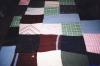
Double sided utility quilt made from machine pieced squares of tailors' samples and men's and boy's suitings. The padding is 5 or 6 layers of pieced used clothing including darned, threadbare socks, part jumpers, blanket pieces etc.
2090 x 1340mm
Eileen Dinning
Double sided silk quilt. One side is paisley designs and the reverse plain silk . Machine pieced. There is a thin padding possibly sheeting.
2694 x 2287mm
Gillian Sullivan
Quilt made of 9120 very small Suffolk Puffs, each one about the size of a 20 cent piece. "Each piece backed and the front of it drawn up like a reticule. It was not backed and was rather fragile, so I backed it on to a sheet, as it was heavy and in danger of tearing when lifted." [Gillian Sullivan]
2360 x 2230 mm
Gwen Cordinglay
Patchwork quilt made from hexagon patches in silks and rayons, in pinks, blues, red, yellow mainly, with pastels. No padding. Bordered and backed with green satin.
1829 x 1372mm
National Gallery of Australia
" Reversible patchwork quilt of woollen suiting/upholstery fabrics in khaki, greys, blues and browns. Both sides have different designs. The front of the quilt has 13 rows of 12 vertical rectangles flanked on either side by a column of 22 horizontal rectangles. The reverse has a more interesting and complex design of small and very large rectangles, squares and triangles; with khaki contrasting with the duller greys and blues. The patchwork layers are joined at the edges with machine stitching and the quilt is machine quilted along 3 horizontal lines following joins in the patchwork; therefore not being totally straight. These lines are more noticeable on the reverse. The reverse face has been on display at the NGA." [NGA] There is a cotton blanket used as padding. 2054 x 1451mm
Glenda Wilkinson
Quilt consisting of 30 blocks 360 x 360mm each (5 x 6). Each block consists of squares and rectangles arranged diagonally and edged with triangles. Each block is made from 2 or 3 different cotton materials, different colours but mainly pastels. It has not been quilted but tied with pink wool with 5 ties per block. Machine sewn with a folded and machine stitched edge. Padding appears to be coarse open weave cotton. The backing is printed flannelette.
2210 x 1850mm