Quilt No.665DC - Diana Cameron

Diana Cameron
Owner: 
Diana Cameron
Location: 
QLD South West
Maker
Maker: 
Jane Cobbold
Made in
AUSTRALIA VIC
Date: 
1881 - 1900
Description: 
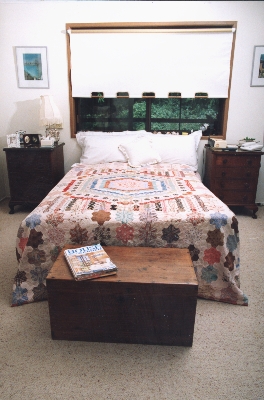
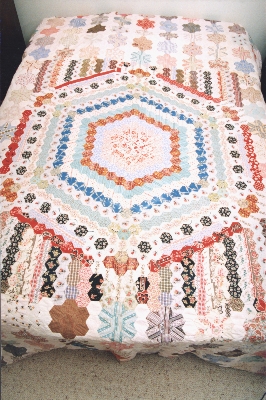
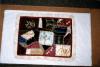
Cotton quilt of patterned and plain hexagons with central design and borders of hexagons radiating from it. It is hand sewn and most patterns are of roses. Backing is pink sateen and is a replacement backing put on in 1939. Pieced over papers, remnant love letters were found when the new backing was put on.
1981 x 1525mm
History: 

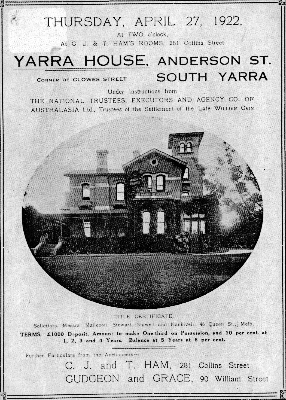
The quilt was hand sewn by Jane Cobbold (Cain) c.1880 at 'Yarra House' in South Yarra, Melbourne and passed to the present owner's great aunt and then to her mother and is now owned by Diana Cameron. It is used occasionally.

Story: 

Diana Cameron's grandmother, Jane Cobbold, was born in England and came to Australia as William Cain's bride c.1875. 'Yarra House' in Anderson Street, South Yarra was built by William Cain who was mayor of Melbourne (before it was a city so he was not Lord Mayor) about 1890. It is opposite the Botanic gardens and the Cains entertained lavishly for over a decade. 'Yarra House' is now Merton Hall and part of the Melbourne Church of England Grammar School.
Diana Cameron, the present owner, went to the Goondiwindi district as a young bride and the quilt has always been part of her married life.
[Compiled from notes supplied by the owner]
Related Quilts:
Christine Barnes
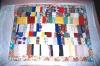
Cotton quilt . Blue squares with evry alternate square cream with an appliqued butterfly. Blue border. Completely hand quilted. Light weight padding and cotton backing .
2743 x 1829mm
Gillian Sullivan
Quilt made of 9120 very small Suffolk Puffs, each one about the size of a 20 cent piece. "Each piece backed and the front of it drawn up like a reticule. It was not backed and was rather fragile, so I backed it on to a sheet, as it was heavy and in danger of tearing when lifted." [Gillian Sullivan]
2360 x 2230 mm
Powerhouse Museum
"A tied patchwork wagga quilt made from swatches of men's wool suiting fabrics in blue/grey and pink/brown tonings. Rectangular swatches have been cut in half diagonally, and the resulting right-angled triangles paired to form larger equilateral triangles which alternate dark with light across the field. The quilt has been machine and hand pieced, then machined in vertical stripes.
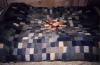
The centre field is bounded by two strip-pieced borders at top and bottom, and three down each side. These are sewn from rectangles, using light pink/brown tones for the inner border and darker colours for the outer borders. The quilt is padded and backed and the side seams are secured with black herringbone stitch. The three layers are tied together invisibly with lazy daisy stitches in black cotton from the back." [PHM] The padding is a wool blanket and the backing is two pieces of cream twill cotton.
2030 x 1440mm
National Gallery of Australia
" A wide range of cotton fabrics have been used to make this quilt in the traditional log cabin style. The strips of the log cabin are joined by rows being hand sewn onto a small square backing fabric, each square of strips has then been hand sewn together to form the quilt. The work is backed with a sateen printed fabric decorated with paisley design. A strip of the lining trims the edge of the front face of the quilt. The lining is attached with machine stitching. There are numerous tacking stitches that remain in the front face of the quilt. There are approx 9000 pieces in the quilt, most being only 5mm in width.
The quilt is of three layers because the strips of the log cabin are attached to a backing piece, and then the quilt is lined; however it is not padded." [NGA]
Jillian Towers
Hand pieced patchwork quilt with 10 diamonds consisting of hexagons with white and black rows as edging. Materials include furnishing and dress materials and a type of linen. It is not quilted or tied. The backing is a small floral print in flannelette.
2180 x 1830mm
National Gallery of Australia
" Reversible patchwork quilt of woollen suiting/upholstery fabrics in khaki, greys, blues and browns. Both sides have different designs. The front of the quilt has 13 rows of 12 vertical rectangles flanked on either side by a column of 22 horizontal rectangles. The reverse has a more interesting and complex design of small and very large rectangles, squares and triangles; with khaki contrasting with the duller greys and blues. The patchwork layers are joined at the edges with machine stitching and the quilt is machine quilted along 3 horizontal lines following joins in the patchwork; therefore not being totally straight. These lines are more noticeable on the reverse. The reverse face has been on display at the NGA." [NGA] There is a cotton blanket used as padding. 2054 x 1451mm