Quilt No.734MF - Maria Finlayson

Maria Finlayson
Owner: 
Maria Finlayson
Location: 
NSW Sydney
Maker
Maker: 
Margaret Smith
Made in
AUSTRALIA Sydney
Date: 
1921 - 1940
Description: 
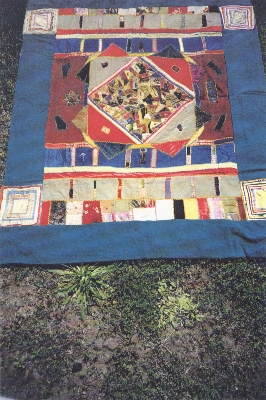
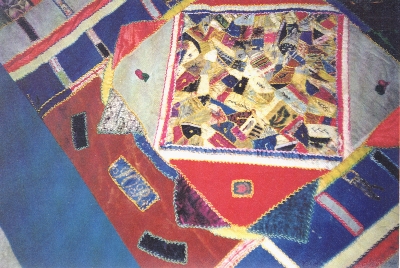
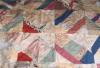
Crazy patch with frame centre set on point; worked in silks. Surrounding area pieced mainly in velvets and corduroys, with some more silks. A wide border of bright turquoise corduroy. Seams are covered with feather stitch. Quilt includes boy sout badge, union jack badge, Indian type medallion and initials 'IOR' in metallic thread. There is no padding and it is backed with green gingham.
1730 x 1325mm
History: 

The quilt was made by Margaret Smith (1857-1950) probably in Sydney and probably in the 1920s or 1930s. The quilt was owned in the past by Victoria Caines (maker's daughter) then Walter and June Caines (maker's grandson) and now Maria Finlayson, great-grand-daughter of the maker.

Story: 

"My Father (maker's grandson) was in the Boyt Scouts, so I suspect the Scout badge on the quilt was his. Margaret Smith was the generation that was devoted to the royal family and thought of England as the Mother country, though they were born and bred in Australia and had never been there. This could explain the union jack.
She had a hard life. She returned to Australia with her only child (my grandmother) after some time in New Zealand. Her husband was supposed to meet her on the wharf but her didn't show up and was never heard of again. She worked as a cleaner to support herself and her daughter. She was a strict Methodist and a very gentle person. My father had very fond memories of his tiny grandmother."
[Maria Finlayson 28.4.00]
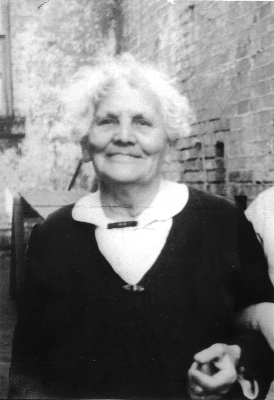
Margaret Smith c.1940

Related Quilts:

National Trust of Australia (SA)
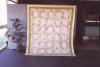
Double bed patchwork coverlet of pieced blocks in a pinwheel or dresden plate pattern of prints on a cream ground, each block with a 1 3/4" border or sash. Each pinwheel has 10 pieces, and the quilt is constructed 8 blocks by 6. Cotton fabrics are in florals, checks and stripes, in blues, greens browns, pinks, purple. The quilt was in poor repair and has been reduced in size. Conservation work has been done by the State Conservation Centre.
Backing or filling unknown.
Jindera Pioneer Museum
Quilt made of 26 x 13 rectangles of woollen men's suiting samples. Each rectangle is about 70 x 130 mm. Wide variety of patterns, mainly stripes, and colous. The padding is part of a worn cream blanket and joined pieces of woollen clothing. The backing is a well worn piece of brushed cotton. Machine made.
11900 x 1870 mm
The Pioneer Women's Hut
Continuous 'sleeve' of hand sewn small hexagons, many woollen, some joined, some darned, plain and patterned. Several bands of plain coloured hexagons. The padding is ticking, an old cream blanket and part of a bedspread.
1960 x 800mm
West Australian Quilters' Association
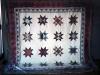
The quilt is a repeat block in the Ohio Star pattern in turkey red and cream. Quilted in squares in the cream block and diagonal lines in the star block. The fabric border is disintegrating. The backing is cream calico and the padding is cotton, badly degraded. 1940 x 1760mm.
Powerhouse Museum
"A tied patchwork wagga quilt made from swatches of men's wool suiting fabrics in blue/grey and pink/brown tonings. Rectangular swatches have been cut in half diagonally, and the resulting right-angled triangles paired to form larger equilateral triangles which alternate dark with light across the field. The quilt has been machine and hand pieced, then machined in vertical stripes.
The centre field is bounded by two strip-pieced borders at top and bottom, and three down each side. These are sewn from rectangles, using light pink/brown tones for the inner border and darker colours for the outer borders. The quilt is padded and backed and the side seams are secured with black herringbone stitch. The three layers are tied together invisibly with lazy daisy stitches in black cotton from the back." [PHM] The padding is a wool blanket and the backing is two pieces of cream twill cotton.
2030 x 1440mm
Elsie Roberts
Patchwork quilt has a centre of a square within a square, with rows of scraps added around it. The scraps are mainly cotton shirting fabrics and are cut in different sizes and shapes. The two long sides have a narrow red edging folded from the back. The other two sides have been 'bagged'. Filling is an unusual weave thought to be wool. Backing is a pink, red and beige floral cotton.
2080 x 1650mm