
Quilt No.755PHM - Powerhouse Museum
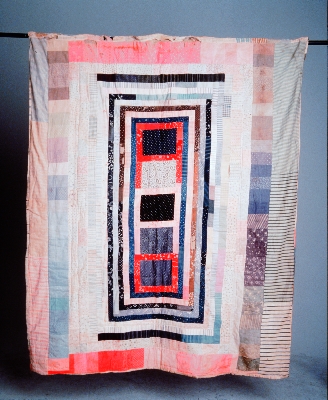
Description:
"A double sided rectangular patchwork quilt with blanket inlay. On the face side, the patchwork pieces are arranged in long rectangular strips, laid 'log cabin style' and dimishing in size, around the rectangular medallion. This is composed of a column of 5 patches with narrow strip borders. The colours are strong in the centre of the quilt and become softer toward the edge. The patches that make up individual strips are the same toning with a variety of dot, stripe, check and small floral patterns. The quilt has been hand and machine stitched.
The reverse of the quilt has been similarly...
The reverse of the quilt has been similarly...
History:
"In 1983 the quilt was brought to Elizabeth Bay House by an elderly man who had seen their 'Good Housekeeping' exhibition. He called the quilt a 'wagga wagga', and asked that a suitable place be found for it if it could not be kept at Elizabeth Bay House. With his permission and with the proviso that he remain annonymous, the quilt was then given to the Powerhouse Museum.
"The donor indicated that the 'wagga wagga' was made from an old woollen blanket and material scraps. It seems likely that his mother made it about 1900." [PHM]
Related Quilts:
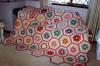
Hexagon quilt in pattern known as 'Grandmother's flower garden'. Hexagons of prints and plains with yellow centre to each flower, and plain pink outlines. It is hand pieced and hand quilted. Padding is cotton, backing is cream cotton. 2200 x 2000 mm.
Hexagons appliqued onto sheeting. 5 groups of 6 hexagons in centre of sheet and continuous row of hexagon rosettes around border.
2261mm x 1664mm
2261mm x 1664mm
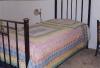
Cotton quilt with central frame and radiating borders mainly in squares in pinks and blues, printed materials and plain. The padding is cotton wool and the backing is off white cotton.
2040 x 1800mm
2040 x 1800mm
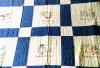
Patchwork quilt made for a child. All cotton with cotton padding. White blocks have embroidery depicting different nursery rhymes eg Mary, Mary, Quite Contrary ; Old Mother Goose. These blocks are separated by rectangular strips of teal cotton. The quilt is hand stitched and heavily quilted.
1677 x 1271mm
1677 x 1271mm
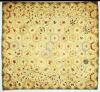
"This quilt follows the traditional hexagon patchwork pieced pattern, which are then joined and sometimes edged with a contrasting border. The edges of the quilt have been turned and then scalloped edges made of identical patches to the main body of the quilt have been attached to the edge. The quilt is fully lined, and the lining is visible front the front face through the gaps between the scalloped edge. The lining is attached to the patchwork with a row of stitches along the edges; there are no stitches in the centre field. The fabrics of the quilt are plain weave cotton in simple floral and geometric designs. Most of the fabrics are monochromatic. Several different colour ways of the same fabric are evident which could suggest some fabrics were from manufacturer samples. The lining is a William Morris print.
Each of the patchwork pieces (there are several thousand present) are sewn together with very fine overcasting stitches. The quilt is entirely hand sewn. There is some evidence that templates from the hexagon pieces possibly blotting paper, remain in situ���The quilt is not padded or quilted. The lining is fine twill weave cotton printed in pink and pale purple. The design follows William Morris's 'Strawberry Thief design'." [NGA] 2075 x 1911mm
Each of the patchwork pieces (there are several thousand present) are sewn together with very fine overcasting stitches. The quilt is entirely hand sewn. There is some evidence that templates from the hexagon pieces possibly blotting paper, remain in situ���The quilt is not padded or quilted. The lining is fine twill weave cotton printed in pink and pale purple. The design follows William Morris's 'Strawberry Thief design'." [NGA] 2075 x 1911mm

Crazy patchwork quilt in silks and velvets. Centre circle of embroidered flowers and outer border of diamonds in tunbling block pattern. Most pieces have embroidered flowers and all joins are embroidered in fancy stitches. The owner's mother had a pink silk quilted backing and a thick edge cord added to the quilt by Rocke's of Collins street Melbourne c.1960
1620 x 1595mm
1620 x 1595mm