Quilt No.801DA - Dora Andonaros

Dora Andonaros
Owner: 
Dora Andonaros
Location: 
ACT
Maker
Maker: 
Unknown
Made in
GREECE Lemnos
Date: 
1941 - 1970
Description: 
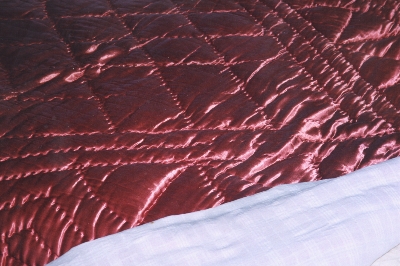
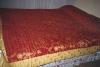
Wholecloth quilt made from deep cherry red satin with a backing of red cotton. The padding is cotton wadding. It is hand quilted and the pattern is a central motif of a large diamond with diamond fill. Each corner has a pattern of curved lines and the quilt border is created by four parallel lines.
2070 x 2000mm
History: 

The quilt was made by a local quiltmaker on the Greek island of Lemnos, village of Varos in 1957. It was ordered by Mary Kalenteridis, already in Australia, for her young daughter Dora's trousseau. It was brought to Australia by Mary's brother Christos. Dora Andonaros is the only owner. It is still used.

Story: 

"Dora's Paploma
In 1957 Mary (Zaimis) Kalenteridis came to Australia with her three daughters, Kristalo, Dora (Theodora), and Ellie, leaving behind their village of Atsiki, on the beautiful north Aegean island of Lemnos, Mary's husband George had preceded them eighteen months earlier. After a time in Canberra, the family moved to Goulburn NSW, where their fourth daughter, Bella, was born, and where George owned a men's barber shop for many years.
Although the girls were young, when they arrived - Dora was only seven, Mary wanted them to have a proper 'prika' (trousseau) in preparation for when they would be old enough to marry. So, a short time after arriving, Mary sent back to her island and ordered three quilts, which her brother Christos brought out. The cotton used in their making was grown on Lemnos, and indeed, one of Dora's enduring childhood memories is of her mother, helping to pick cotton at her grandfather's farm. Mary explains that: 'Paplomata (quilts) were considered a top priority for girls. All handmade, they come in different patterns and designs. Often we would pin a 'sindoni' (embroidered shee)t on to the bottom of the paploma, to protect it. The sheet would be removed for washing or for the 'yiortes', special feast days'.
Dora is very fortunate to have such a 'sindoni', handed down from her mother; handwoven on a traditional 'argalio' (loom) and embroidered with the initials, E.X, of the maker. Together the sindoni and paploma stand as symbols of age-old customs and traditions, and of the changes which inevitably happen through migration.
Dora's husband John also came to Australia from Lemnos. They owned a shop for seventeen years, but now live on their five acre farm where they have a vineyard, olive trees and honeybees. Dora and John have two sons, Paul and George; and a daughter Chrisoula. She and her husband Dimitri have a daughter, Evelyn."
[Written by Lula Saunders; adapted from interview 10.1.01 for the National Quilt Register]
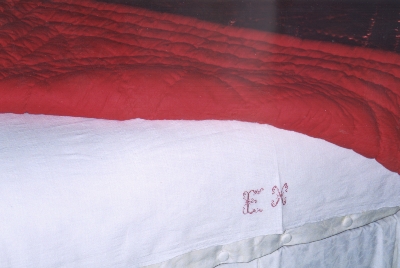
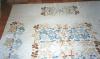
Quilt showing the hand woven embroidered sheet

Related Quilts:

Yvonne Hamdorf
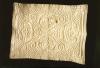
Wholecloth pram quilt with a top of pink cotton sateen, and the reverse is a more finely woven, ivory, fabric. All over quilting design as main feature, with stylised hearts, leaves and cross hatching. The padding is cotton batting. 870 x 660 mm.
John Tomkin
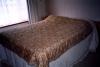
Hand stitched, cotton, appliquéd, quilt in a flower pattern on a plain background. Colours are shades of green, apricot and browns. This quilt was known as a 'Bride's Quilt'. Padding is thought to be layers of white fabric raised almost like a wadding. The backing is cotton material. 2470 x 2020 mm.
Maria Patounas
The cotton quilt top is blue featuring a floral design in the centre and a matching border. The main quilting pattern relates to this. There is a wide gold cotton border with a quilting pattern of parallel lines and diamonds. The backing is plain red cotton. The padding is cotton wadding.
2040 x 1750mm
Alysoun Ryves
Red Applique on an off white background. All applique is by hand using herringbone stitch. Three different red materials are used for the applique each printed with a different tiny all over pattern. There are 3 different applique shapes: the 9 major shapes have 8 points; the daisy pattern has 8 petals; the edge pattern is used along the top, left and half of the bottom edge of the quilt and sometimes has 4 points, sometimes 3 and sometimes 2. There is a tiny red piping around the quilt along the bottom and both sides. It is hand quilted in 100mm long zig zags 12mms apart all over the quilt. The quilt is signed twice on the front, once in ink and once in embroidery. It is signed 'Anna Edwards Jan 1858'. There is no padding and the backing material is similar to the off white background material of the top.
2270 x 2180mm
National Gallery of Australia
"This is a coverlet of pale blue cotton muslin, highly decorated with appliquéd pieced bands, figures, and embroidery. The edge of the quilt is finished with bands of yellow, white and green cotton attached with ladder stitch.
Down the centre field of the design and 4 poems embroidered in quite crude chain stitch. Each piece of prose is accompanied by an appliquéd illustration. For example a large clock accompanies a poem of time. 'While shepherds watch their flocks at night�.'is illustrated with a beautiful scene of the manger watched by an angel, cows and sheep. The appliqué and embroidery is executed crudely with large stitches in running and overcasting. The quilt is signed, 'M.J.H. aged 84 yrs.1924.' " [NGA] There is no padding or lining. 1640 x 1540mm
Santa Maltese
A 'foot' quilt, "copri piedi" used on the bed. Pink satin top and blue satin backing. The pink top is hand embroidered in a trellis pattern in shadow stitch and within each section there are hand embroidered sprigs of flowers in silk threads. The whole top is elaborately quilted. The silk cord binding is twisted into four decorative loops at each corner. There is a thick padding of cotton grown locally in Sicily.
1260 x 650mm