Quilt No.866AG - Annette Gero

Annette Gero
Owner: 
Annette Gero
Location: 
NSW Sydney
Maker
Maker: 
Lillian Head et al
Made in
AUSTRALIA NSW
Date: 
1921 - 1940
Description: 
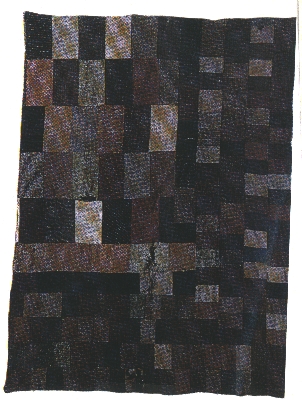
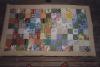
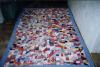
Double sided quilt made from mainly rectangular pieces of woollen tailors' samples and suiting materials. It is machine sewn and there is no padding.
1670 x 1220mm
History: 

Made by Lillian Head and her mother and aunts in Sydney c.1930. Now in the collection of Annette Gero.

Story: 

"Lillian Head and her mother and aunts ran a 'sweat shop' in the back of their house in Petersham Sydney, where they stitched up vests (illegally) for extra cash. With the remains and spare suiting they made 'depression' waggas from the tailors' samples and off cuts. These were made together with her mother, grandmother and her aunts from the 1920's through to the 1940's."
" 'The backroom of our house was turned into a sewing room with two sewing machines. We used to go to Blackmore's Tailors near St. Peters (Sydney) and pick up pre-cut men's vests, which we took home to sew. The tailor often gave us swatches and offcuts from which we produced waggas - we gave many away. They were often lined with sugar bags which we got from the grocers. We were making them in 1927 when the Duke and Duchess of York (later King George VI and the present Queen Mother), came to Australia to open Parliament House and I remember taking along a box of swatches to sew whilst waiting to see their carriage pass when they opened the Royal Agricultural Show in Sydney that year.'
After Lillian's marriage in 1940 she continued to make them for her children up till 1947."
[Annette Gero]
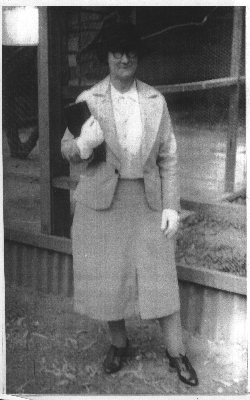
Lillian Head
Lillian Head

Related Quilts:

Muriel Hartmann
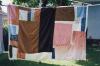
Domestic Wagga made from sugar bags joined together and covered with army blankets. Machine construction. Patching evident. Sugar miller's brand visible on one bag: " M--AQUIN, 70lbs, --- SUGAR, BUNDABERG"
1753 X 1347mm
June Johnson
Hand sewn cotton cot quilt with pattern of red and white lozenge shaped hexagons measuring approximately 65mm from top to bottom. A centre flower is constructed from 2 circles of 19 hexagons in red and white. This is surrounded by 8 smaller hexagon flowers. Additional single red hexagons are scattered at random on the white background around the rows of flowers. The quilt is not quilted or tied but is attached at all 4 edges. Writing on the back of the quilt (probably added later) reads "Made by Sarah Hodge, Newport, Wales UK for her first child John." There is no padding and the backing is white cotton. 1000 x 1250 mm.
National Gallery of Australia
" Reversible patchwork quilt of woollen suiting in grey, blue, navy, maroon and brown. The fabrics appear to be new tailor's sample pieces (the sizing is still present on the fabric, signifying it has never been washed). The patches are rectangular and vary in size. Both sides have different designs. The front of the quilt has 4 rows of 12 vertical rectangles then below this are 4 rows of 7 horizontal rectangles followed below by 4 rows of 11 vertical rectangles. The reverse of the quilt has a section at the top and bottom composed of 5 rows of 9 horizontal rectangles. The central area is made up of a centre section of 6 rows of 5 vertical rectangles; flanked on either side by a column of 10 horizontal rectangles and two columns of 8 smaller vertical rectangles.
The patchwork layers are joined at the edges with machine stitching. The patchwork layers and padding are machine quilted on the front down 2 vertical lines following joins in the patchwork; therefore not being totally straight. The lines are more noticeable on the reverse as the 2 sides do not match. The front face is displayed at the NGA.
Between the patchwork layers is a striped cotton blanket in black, sky blue, white and cream." [NGA]
2082 x 1386mm
National Gallery of Australia
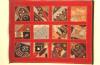
"The Rajah "quilt" is a patchwork and appliquéd bed cover or coverlet. It is in pieced medallion or framed style: a popular design style for quilts in the British Isles in the mid 1800's. There is a central field of white cotton decorated with appliquéd (in broderie perse) chintz birds and floral motifs. This central field is framed by 12 bands or strips of patchwork printed cotton. The quilt is finished at the outer edge by white cotton decorated with appliquéd daisies on three sides and inscription in cross stitch surrounded by floral chintz attached with broderie perse on the fourth side. All fabrics used in the Rajah quilt are cotton with the exception of small amounts of linen and silk threads. The quilt shows evidence of being produced by many hands." [NGA] The quilt is not padded or lined. 3372 x 3250mm
June Dean
Pieced hexagons, English paper method. Large hexagons form the centre with a border of smaller hexagons. The fabrics are all cotton in a wide range of colours and patterns. There is no padding. The backing is cotton, large white floral design on dark blue. The hexagons are hand pieced and the edges machined.
2480 x 1420 mm
Catherine Ringwood
The top of this quilt is 6 x 5 alternating squares and rectangles of check woollen material in 12 or more colour ways. Herringbone stitch in yellow stranded cotton is worked along each join and border.The border is plain grey wool. There is no padding and the backing is light blue crepe.
1118 x 814mm