
Quilt No.982SB - Sheila Bruhn

Owner:
Sheila Bruhn
Location:
NSW Sydney
Maker
Maker:
Changi Prison Girl Guides
Made in
SINGAPORE Changi Prison
Date:
1941 - 1970
Description:
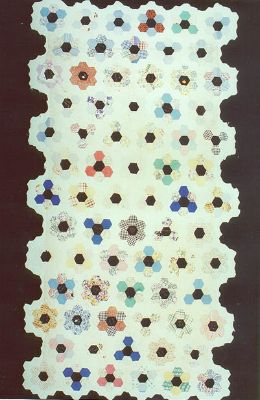
Quilt constructed of blocks of hexagons with 72 'flower' rosettes made from plain and printed cotton scraps. The centre of each rosette has the name of one of the Girl Guides embroidered on it. The one in the centre of the quilt has the Trefoil insignia outlined in satin stitch. The background is white hexagons. There is no padding and it is backed with white cotton. 1880 x 960mm
History:
The quilt was made by Girl Guides in Changi prison camp in 1942. Elizabeth Ennis, who started the project, took the quilt to Scotland with her when she left the camp in 1945 after the war ended. 'Trish' Ennis gave it to the present owner, Sheila Bruhn, in April 2001 and it is now with Sheila in Australia.
Story:
This Girl Guide quilt was put together by a group of girls in Changi Prison. The guide group was started by Elizabeth Ennis, an army nursing sister, with the help of a young Dutch girl, Trude van Roode. There were about 20 to 30 girls between 8 and 13 and they collected oddments of material in the camp. The girls' names are recorded on the quilt.
Related Quilts:
Thick padding for a wholecloth quilt constructed from pieces of old woollen clothing. The backing is a calico sheet. Originally had a cretonne cover.

Pieced wool quilt, machined. Rectangles and squares, from a wide variety of materials including tartans, checks, tweeds, herringbones, joined in strips and then the strips joined. The backing is scraps of woollen material with a seal motif aookiqued on. There is no padding.
1350 x 800mm
1350 x 800mm
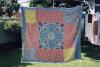
One side of this quilt is large pieces of check and striped material surrounding a small patterned supper cloth with a border of scrap pieces. The other side is small, floral, check, spotted, striped and plain cotton pieces surrounding a tablecloth. It is machine sewn and is not quilted. The padding is an old woollen blanket.
1825 x 1625mm
1825 x 1625mm
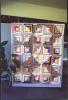
Log Cabin quilt made from a variety of cottons and silks. There is no padding and the backing is calico bags. 1500 x 1250 mm.
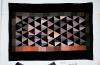
"A tied patchwork wagga quilt made from swatches of men's wool suiting fabrics in blue/grey and pink/brown tonings. Rectangular swatches have been cut in half diagonally, and the resulting right-angled triangles paired to form larger equilateral triangles which alternate dark with light across the field. The quilt has been machine and hand pieced, then machined in vertical stripes.
The centre field is bounded by two strip-pieced borders at top and bottom, and three down each side. These are sewn from rectangles, using light pink/brown tones for the inner border and darker colours for the outer borders. The quilt is padded and backed and the side seams are secured with black herringbone stitch. The three layers are tied together invisibly with lazy daisy stitches in black cotton from the back." [PHM] The padding is a wool blanket and the backing is two pieces of cream twill cotton.
2030 x 1440mm
The centre field is bounded by two strip-pieced borders at top and bottom, and three down each side. These are sewn from rectangles, using light pink/brown tones for the inner border and darker colours for the outer borders. The quilt is padded and backed and the side seams are secured with black herringbone stitch. The three layers are tied together invisibly with lazy daisy stitches in black cotton from the back." [PHM] The padding is a wool blanket and the backing is two pieces of cream twill cotton.
2030 x 1440mm
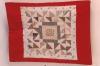
Frame cot quilt in cotton fabrics, the centre square in a paisley print surrounded by two plain borders or frames, then two frames pieced in alternate light and dark triangles, then a frame in a floral print. Outer border is of red fabric, longer at top and bottom to make a rectangle. No quilting. Machine sewn.
1050 x 770mm
1050 x 770mm