Quilt No.1023JL - Joyce Lannin

Joyce Lannin
Owner: 
Joyce Lannin
Location: 
WA Country
Maker
Maker: 
Joyce Lannin
Made in
AUSTRALIA WA
Date: 
1941 - 1970
Description: 
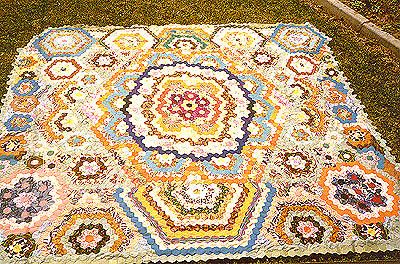
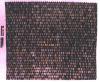
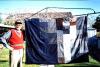
A hand sewn quilt of more than 6,536 hexagon pieces in cottons, silks and polyester mix. There is a centre circular pattern of hexagons within a larger hexagon and small hexagons form larger hexagons in a random pattern on the quilt top. There is no padding and the backing is a plain fawn sheet with a floral edging in hexagons. 2880 x 2550 mm.
History: 

The quilt was made by Joyce Lannin at Lake Grace, Western Australia in the 1960s. It is still owned by Joyce and is used at her home at Lake Grace.

Story: 

Joyce Lydia Lannin. "As long as she can remember, Joyce has had an interest in sewing. As a small child she sat and watched her mother sewing at the machine or doing fancy work by hand so it is not surprising that she soon had a needle and cotton in her hands
When her mother began doing patchwork it was no wonder that Joyce took an interest in that too. From her mother she obtained her first hexagon template and was soon spending all her spare time sewing medallions together to make her first quilt. She worked the medallions in patterns as the ideas came into her head with the result that the quilt is very beautiful. At this time there were no books as it was before patchwork became popular.
After completing the first quilt Joyce decided to make a quilt for each of her four granddaughters. These quilts were made with large patches forming stars in the colours of their bedrooms. They are all different as the patches are arranged differently and thus each has its own appearance."
�������.."Joyce has only made her quilts from patches she has in her scrap box. They have all been made by hand and sewn by hand. The backs are all made from sheets with a row of patchwork flowers at the edge." [Joyce Lydia Lannin]

Related Quilts:
Art Gallery of South Australia
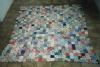
Patchwork quilt made of hexagons in cottons in a variety of prints. The patches are arranged in the 'Grandmother's Flower Garden' pattern, with dark patches around a light centre patch. The 'paths' are cream cotton. The border is made from diamond shapes placed alternately vertical and horizontal, between two edges of red striped fabric, with mitred corners.
No padding. Backing is red cotton, embroidered 'M.A. Wilson 1863'. Handsewn.
2500 x 2170mm
The Queensland Women's Historical Assoc.
Cotton quilt , octagons of printed floral joined with squares of printed and plain. Yellow floral border. Cotton backing with very intrictae pattern in machine stitching.
2540 x 2490mm
National Gallery of Australia
" This is an unfinished section/piece of crazy quilting. Ribbons divide the piece horizontally into three sections; between these are bands of pastel fabrics and embroidery in the crazy quilt tradition. The fabrics and threads employed are very luxurious: laces, satin ribbons and silk velvets. The embroidery is very fine, employing a wide variety of stitches and threads. This patchwork piece is padded with cotton wadding and backed with tarlatan." [NGA] 1170 x 1020mm
National Trust of Australia (SA)
Randomly patched quilt in many different colours and fabrics. There are appliquéd shapes over many pieces including Suffolk Puffs, hearts, hexagons and other shapes. There is an embroidered inscription "A11 to S11 1829" which is thought to mean AN to SN 1829. There is no padding and the backing is white cotton.
2000 x 2200mm
Susan Shannon
This hand pieced and hand quilted hexagon quilt is in a pattern often called 'Grandmother's Flower Garden'. The background is white and there are concentric rows of double rosettes each with a yellow centre. The colours start in the centre of the quilt with pink and then follow the rainbow. Paper templates were used. The padding is cotton (American) and the backing is cotton floral poplin.
2360 x 1730mm
Robyn Gallaway
Machine made cotton quilt with 100mm cotton squares placed diagonally with peaks running around the edge. The colours are mainly autiumn tones and the patterns include checks, tartans, florals, geometric and plains. Materials were scraps left over from sewing projects such as children's clothes. There is a matching valance.