
Quilt No.49EB - Elsie Bennett
Owner:
Elsie Bennett
Location:
NSW Riverina
Maker
Maker:
Elsie Bennett
Made in
AUSTRALIA NSW
Patterms
Date:
1941 - 1970
Description:
Domestic Wagga made from bags with a top of irregular patches of cotton material, mainly from dress scraps, and a backing of calico.
1578 x 1094mm
1578 x 1094mm
History:
Made by Elsie Bennett around 1952, and currently used by her at Ariah Park, NSW.
Story:
"� around 1952 I made one [Wagga rug] from wheat bags and made a cover of patchwork pieces from frocks I had made for my daughter or worn out pillow slips or other items. The patchwork is not in patterns but whatever shape suited the bit of material. I still use the Wagga rug on my bed. It is a 3/4 bed size as that was the size bed we had in the spare room when we were first married and since the death of my husband I moved into that size bed."
[Elsie Bennett]
Related Quilts:
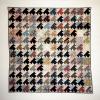
Patchwork quilt of pieced repeat blocks in 'T' pattern,mainly cottons. Quilt is constructed with 12 blocks across and 12 blocks down. Some fabrices have been reused from clothing, some blocks have patches which have been pieced from scraps to make enough fabric for the pattern. Padding is' pellon', quilt is backed, bound and quilted.
1600 x 1500mm
1600 x 1500mm
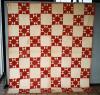
The quilt is a repeat block in the Ohio Star pattern in turkey red and cream. Quilted in squares in the cream block and diagonal lines in the star block. The fabric border is disintegrating. The backing is cream calico and the padding is cotton, badly degraded. 1940 x 1760mm.
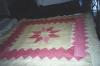
Quilt of pale yellow cotton sateen with a centre star motif with 8 points in pink cotton sateen. A border of pink cotton sateen has pink triangles on each side. The quilt is machine sewn and elaborately hand quilted with designs including fleur-de-lys shape, feathers, vine pattern, clam shells, 8 petalled flower and cable pattern with the main ground cross hatched. The backing is pale yellow cotton sateen.
2235 x 2065mm
2235 x 2065mm
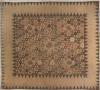
This quilt is of hand pieced hexagons randomly placed and stitched on to a linen backing. They are mainly dress fabrics and chintz with some hexagon flowers in the centre and corners in broderie perse. There is no padding.
2600 x 2600mm
2600 x 2600mm
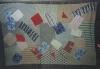
The top is mainly squares of flannel machined together with patches of dress materials stitched randomly on top. There is no padding and the backing is calico. The top and backing are held together by a binding only. It is one of a pair.
2010 x 1680mm
2010 x 1680mm
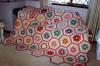
Hexagon quilt in pattern known as 'Grandmother's flower garden'. Hexagons of prints and plains with yellow centre to each flower, and plain pink outlines. It is hand pieced and hand quilted. Padding is cotton, backing is cream cotton. 2200 x 2000 mm.