Quilt No.768PHM - Powerhouse Museum

Powerhouse Museum
Owner: 
Powerhouse Museum
Location: 
NSW Sydney
Maker
Maker: 
Unknown
Made in
ENGLAND
Date: 
1901 - 1920
Description: 
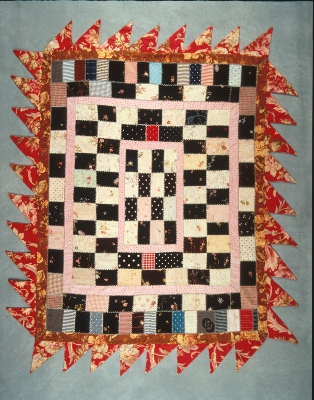
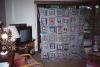
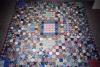
"A medallion style, handpieced cot quilt with dark and light checkerboard patterning of rectangular cotton printed fabrics, probably taken from a fabric sample book. Two frames of pink cotton strips printed with navy blue polka dots outline the central block and separate the outer rows of patches. The quilt is edged with narrow strips of brown floral cretonne and dramatic triangular 'flames' of red floral cretonne attached all around. The seams joining the patches are oversewn with blue featherstitch embroidery, and the quilt is backed with printed cotton." [PHM] There is no padding.
1480...
History: 

"The maker is unknown but is probably a woman from northern Lancashire. She was about 80 when she made the quilt and gave it to Annie Dixon, who lived in the same area, sometime before 1920. This was said to be her last quilt." [PHM] When Annie died her niece Margaret Juckes inherited the chest and its contents, which were sent to Australia in 1960. The Powerhouse Museum bought the quilt in 1989.

Story: 

"The quilt was once owned by Annie Elizabeth Dixon, who was born in 1880 and died in 1959/60. She spent her early years at Aynsome Farm (or Mill) near Cartnel in Northern Lancashire, then moved to nearby Kent's Bank. Annie migrated to Canada in 1920, leaving the quilt in England in a chest of things belonging to her. When Annie died her neice Margaret Juckes inherited the chest and its contents, which were sent to Australia in 1960��.." [PHM]

Related Quilts:
Tasmanian Museum and Art Gallery
Machine sewn reversible quilt. Side 1 is rectangles of men's suiting samples in mainly grey, navy and black, stripes and self patterns. Side 2 is men's suiting samples but also includes woollen rectangular pieces in plain blue and deep pink. There is a hand sewn binding of fine orange-brown wool. The padding is hessian and cotton.
1460 x 1100mm
Fiona Gavens
Hexagon quilt constructed over papers; all seams oversewn with featherstitch embroidery. Materials are vyella and clydella scraps from childhood dresses of the maker's first four children, augmented with scraps from a dressmaker and a book of samples. There is no padding; backing is plain, pale blue, brushed cotton.
2200 x 1720 mm.
Powerhouse Museum
"A tied patchwork wagga quilt made from swatches of men's wool suiting fabrics in blue/grey and pink/brown tonings. Rectangular swatches have been cut in half diagonally, and the resulting right-angled triangles paired to form larger equilateral triangles which alternate dark with light across the field. The quilt has been machine and hand pieced, then machined in vertical stripes.
The centre field is bounded by two strip-pieced borders at top and bottom, and three down each side. These are sewn from rectangles, using light pink/brown tones for the inner border and darker colours for the outer borders. The quilt is padded and backed and the side seams are secured with black herringbone stitch. The three layers are tied together invisibly with lazy daisy stitches in black cotton from the back." [PHM] The padding is a wool blanket and the backing is two pieces of cream twill cotton.
2030 x 1440mm
Beryl Warne
The quilt's construction is cotton patches about 170mm square joined in strips and then the strips joined. The border and backing are pale lemon coloured cotton lawn. The padding is an old woollen blanket. There is ric-rac braid around the border of the top.
2180 x 1420mm
National Gallery of Australia
" Reversible patchwork quilt of woollen suiting/upholstery fabrics in khaki, greys, blues and browns. Both sides have different designs. The front of the quilt has 13 rows of 12 vertical rectangles flanked on either side by a column of 22 horizontal rectangles. The reverse has a more interesting and complex design of small and very large rectangles, squares and triangles; with khaki contrasting with the duller greys and blues. The patchwork layers are joined at the edges with machine stitching and the quilt is machine quilted along 3 horizontal lines following joins in the patchwork; therefore not being totally straight. These lines are more noticeable on the reverse. The reverse face has been on display at the NGA." [NGA] There is a cotton blanket used as padding. 2054 x 1451mm
Gillian Sullivan
Quilt made of 9120 very small Suffolk Puffs, each one about the size of a 20 cent piece. "Each piece backed and the front of it drawn up like a reticule. It was not backed and was rather fragile, so I backed it on to a sheet, as it was heavy and in danger of tearing when lifted." [Gillian Sullivan]
2360 x 2230 mm