Quilt No.384LO'G - Lynette O'Grady

Lynette O'Grady
Owner: 
Lynette O'Grady
Location: 
NSW South Coast
Maker
Maker: 
Women of Reorganised Church of Jesus Christ of Latter Day Saints
Made in
USA
Date: 
1901 - 1920
Description: 
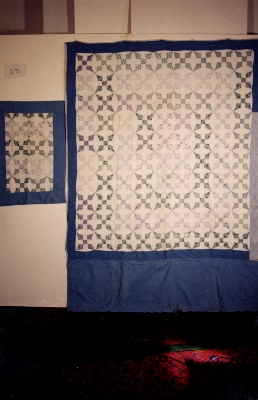
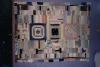
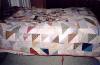
Quilt with white background and blocks in blue and green. 'Robbing Peter to Pay Paul' pattern. Plain blue border. Hand pieced and quilted. Quilt was cut down, worn center piece discarded then quilt pieces rejoined. A cover for the pillow was made from scraps when quilt was cut down.
1930 x 1740mm
History: 

The quilt was made by the ladies of the Reorganised Church of Jesus Christ of Latter Day Saints for Lily Balmour in America (probably Salt Lake City) about 1915. Lily, who was the great aunt of the present owner, gave it to her sister, the owner's grandmother, probably in the 1930s when she had returned to Australia. On her death it passed to her daughter, Lynette O'Grady's Mother (1950s) and then to Lynette in the late 1970s

Story: 

"The quilt was made for my great aunt Lily Balmour (nee White). Lily was married to an American - Alma Balmour, who was an elder / Missionary in the Reorganised Church of Jesus Christ of Latter Day Saint. She travelled with him for his work and after a period in America they were returning to Australia and the ladies of the church made her the quilt as a parting gift. My great aunt eventually gave the quilt to my grandmother (her sister). Because of her constant travelling she had to limit her luggage. The quilt was on the bed in the spare room at my grandmother's home for many years. My grandmother being a very 'practical' woman, as the quilt began to wear, cut it down the center to put the inside out. On her death my mother had it for a while and then she gave it to me. Thirteen years ago we had a house fire. It survived with some scorch marks. We are not sure of the age of the quilt. My Mother is now in a nursing home and is vague about its history."
[Lynette O'Grady 1.8.98]

Related Quilts:
Diane Kern Hamilton
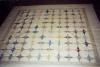
Dresden plate quilt with pointed pieces set around a white centre. Fabrics are checks, floral patterns and plains of the 1930s. The twenty blocks are sashed with plain mauve fabric which does not meet evenly in some places. The padding is two layers of cotton bedspreads. The backing is open weave rough quality cotton.
1860 x 1550mm.
Thelma Lithgow
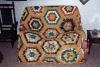
Repeat block quilt top based on hexagons, each 350 mm diameter. Six hexagons and a centre one make a 'flower' and these are set in rows against a plain calico background. Patterned cotton fabrics are used for the hexagons, small prints, fine stripes and tiny flowers. As it is a quilt top only, there is no lining or padding. 2100 x 1800 mm
National Trust of Australia (WA)
Hexagon quilt in dress and shirting cottons constructed in frame style with a centre rosette of 7 patches surrounded by 4 borders of patterned hexagons alternating with cream patches. The quilt has an inner border of triangles then rows of rosettes alternating with cream patches. The outer border is triangles. There is no padding. The backing is cream linen and has had a 20th century white cotton sateen slipstitched to it.
2045 x 1940mm
Old Government House
Patchwork quilt in Log Cabin pattern made from silks, velvet, cottons and taffetas, in prints and plain, around a centre squares of black velvet. Colours are, in the dark sections, blues, greens, browns, yellow and pinks. The base of the blocks is blue and white ticking. The padding is probably cotton. Backing is of green cotton. There is an attached frill on all sides of green cotton, faded to dull light brown.
1630 x 1350mm
Glenda Wilkinson
The quilt consists of 2 layers of random pieces of woollen coating and suiting materials machined together, very dark colours on one side and a mixture of dark and lighter on the other. The 2 layers are quilted together with a row of machining and has a folded and machine stitched edge. There is no padding.
1270 x 950mm
Gillian Sullivan
Quilt made of 9120 very small Suffolk Puffs, each one about the size of a 20 cent piece. "Each piece backed and the front of it drawn up like a reticule. It was not backed and was rather fragile, so I backed it on to a sheet, as it was heavy and in danger of tearing when lifted." [Gillian Sullivan]
2360 x 2230 mm