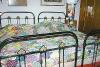
Quilt No.3GW - Gladys V. Williams

Gladys V. Williams
Owner: 
Gladys V. Williams
Location: 
NSW Riverina
Maker
Maker: 
Gladys Williams
Made in
AUSTRALIA NSW
Date: 
1921 - 1940
Description: 
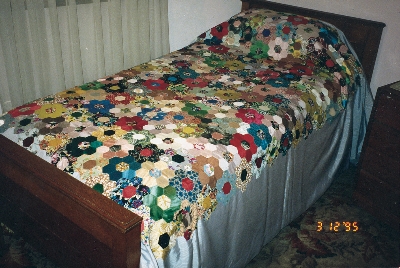
Grandmother's Flower Garden, also known as French Bouquet. The quilt comprises 181 flowers. No padding is used. Each flower has seven hexagonal patches, cut from a metal template pattern. Floral and plain silk materials are used and mounted on pale blue moire taffeta.
3050 x 2031mm
History: 

Made by Gladys V. Williams who started the patchwork in 1937. The quilt completed in 1957. It won second prize in the Royal Sydney Show 1958, first prize Albury Spring Show 1958. The quilt is in regular use in summer months.

Story: 

"This quilt in the beginning was to be a cushion. I was visiting my parents in Launceston, Tasmania, Christmas 1936, when I acquired the first offcuts from my sister, who was a dressmaker, & was making Evening Gowns at the time.
We had two small sons, who were both asthmatics, and it was necessary to spend a lot of time with them. Our mother was an expert needlewoman and had passed on the interest to her daughters. From her Craft Books I became interested in Patchwork.
However, progress was slow and also there was the chase for the off cuts from different sources. When there was enough flowers for a cushion, I had the 'Bug' and kept on.
In 1939 the Second World War began and my husband enlisted in 1941. Before my marriage I was with the Commonwealth Public Service and was called back to work for War Years. So everything was packed away and stored.
The two boys were at school and as you may guess there was not very much spare time.
My husband was discharged September 1945 with War Disabilities, after service in the Middle East & Northern Aust. He took over the management of the family business, with which I was also involved. In 1948 a third son was born and it wasn't until the 1950's that I started up the Patchwork again.
The quilt was finally finished at the end of 1957. I have to thank my sister and many friends for the scraps of beautiful fabrics they collected for me.
I enjoy all kinds of needlework. At present I'm working on Textured Tapestry, using many of the 100 or so different stitches that are available. However, my real love is Hand Knitting and I always have a piece of knitting on the needles."
[Gladys Williams, NSW, 30.1.96]

Related Quilts:
National Gallery of Australia
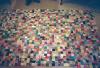
"This quilt follows the traditional hexagon patchwork pieced pattern, which are then joined and sometimes edged with a contrasting border. The edges of the quilt have been turned and then scalloped edges made of identical patches to the main body of the quilt have been attached to the edge. The quilt is fully lined, and the lining is visible front the front face through the gaps between the scalloped edge. The lining is attached to the patchwork with a row of stitches along the edges; there are no stitches in the centre field. The fabrics of the quilt are plain weave cotton in simple floral and geometric designs. Most of the fabrics are monochromatic. Several different colour ways of the same fabric are evident which could suggest some fabrics were from manufacturer samples. The lining is a William Morris print.
Each of the patchwork pieces (there are several thousand present) are sewn together with very fine overcasting stitches. The quilt is entirely hand sewn. There is some evidence that templates from the hexagon pieces possibly blotting paper, remain in situ���The quilt is not padded or quilted. The lining is fine twill weave cotton printed in pink and pale purple. The design follows William Morris's 'Strawberry Thief design'." [NGA] 2075 x 1911mm
Annette Gero
This domestic Wagga is two layers of woollen army blankets with the top layer in rectangles joined in rows. The backing is hessian bags that originally contained meat meal.
11650 x 1130mm
Doncaster-Templestowe Historical Society
Quilt made of Suffolk Puffs or flattened circles, in different bright colours in cotton and silk. Large single bed size.
The Pioneer Women's Hut
Single bed quilt made up entirely of hexagons in 'Granny's Flower Garden' pattern. The rosettes are made up of 8 hexagons and a central one. Native flower prints, including wattle, on a white background. Plain hexagons in white, yellow and blue form a scalloped border. Hexagons are hand stitched and the 2 layers are quilted in running stitch. The backing is a pieced sheet.
2400 x 1500mm
Red Cliffs Historical Society
Large hexagon rosettes in a variety of plain colours. 6 form a flower and each hexagon has a contrasting colour for the centre. Machined smaller hexagons give a ruffled effect. Colours of flowers include teal, burnt orange, pink, lime and mauve. The material is nylon and the backing is a single piece of pink bubble nylon. The padding is a single piece of calico.
2050 x 1530mm
Jindera Pioneer Museum
Quilt made of 26 x 13 rectangles of woollen men's suiting samples. Each rectangle is about 70 x 130 mm. Wide variety of patterns, mainly stripes, and colous. The padding is part of a worn cream blanket and joined pieces of woollen clothing. The backing is a well worn piece of brushed cotton. Machine made.
11900 x 1870 mm