Quilt No.624PWH - The Pioneer Women's Hut

Owner: 
The Pioneer Women's Hut
Location: 
NSW Riverina
Maker
Maker: 
Catherine Anderson
Made in
AUSTRALIA NSW
Date: 
1901 - 1920
Description: 
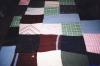
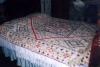
Quilt top of patches of tailors' samples and men's suiting pieces in dark colours, mainly black and grey. Machine construction. It has a border of rose coloured velveteen and the backing is a single piece of cream patterned flannelette.
History: 

The quilt was made by Catherine Anderson of 'Selby Grange' Brockelsby NSW between 1912 and 1827. It was used in Catherine and Robert's home until 1945 when it passed to their son Jack and his wife Evelyn and later their daughter Joan (Hooper) who donated it to The Pioneer Women's Hut. It is displayed occasionally at the museum.

Story: 

Catherine Anderson (born Knese) lived with her husband Robert, and their son, John Henry (Jack) in a wattle and daub house on 'Selby Grange' at Brocklesby, NSW from 1912 to 1927. The quilt was made for general use. When Catherine and Robert retired to Albury they also used the quilt in their new home. Following their deaths in 1945 the quilt was used in Jack's house, with his wife Evelyn and daughter Joan. When Joan married (Hooper) in 1949 she took the quilt and used it mainly while caravanning with young children in the 1950s, 60s and 70s.
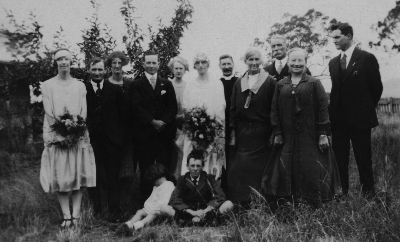
Family wedding group. Catherine Anderson on the right. 1926
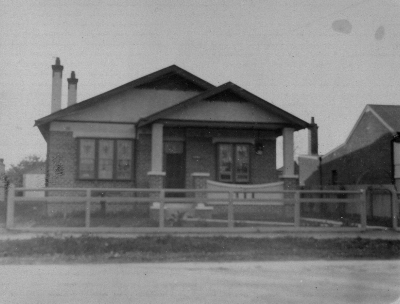
The house Catherine and Robert retired to in Albury

Related Quilts:

Elsie Roberts
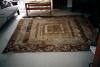
Patchwork quilt has a centre of a square within a square, with rows of scraps added around it. The scraps are mainly cotton shirting fabrics and are cut in different sizes and shapes. The two long sides have a narrow red edging folded from the back. The other two sides have been 'bagged'. Filling is an unusual weave thought to be wool. Backing is a pink, red and beige floral cotton.
2080 x 1650mm
Barbara McCabe
Patchwork quilt made of squares and rectangles in woollen fabric, stitched together without any particular pattern. Colours are mainly green, grey, blue, black, pink and some yellow. Fabrics are plain, checks and stripes. No padding, quilting or binding. Backing is a remnant of synthetic fabric. The quilt has been well sued and is very worn with fabric torn and marked in some places.
1400 x 400mm
The Pioneer Women's Hut
Double sided patchwork quilt. Machined squares and rectangles joined in strips and then the strips joined. Wide variety of materials, mainly woollen from hand or machine knitted jumpers, many patched. All materials came from worn garments from family and friends of the maker. No padding.
1860 x 1410mm
Leila Craig
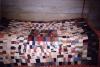
Patchwork quilt of hexagon patches in a variety of colours and fabrics, including cottons, wool, lace, nylon. Edging is of yellow cotton. It is backed but there is no filling or padding.
2470 x 2100mm
June Johnson
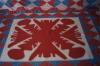
Hand sewn cotton cot quilt with pattern of red and white lozenge shaped hexagons measuring approximately 65mm from top to bottom. A centre flower is constructed from 2 circles of 19 hexagons in red and white. This is surrounded by 8 smaller hexagon flowers. Additional single red hexagons are scattered at random on the white background around the rows of flowers. The quilt is not quilted or tied but is attached at all 4 edges. Writing on the back of the quilt (probably added later) reads "Made by Sarah Hodge, Newport, Wales UK for her first child John." There is no padding and the backing is white cotton. 1000 x 1250 mm.
National Gallery of Australia
"This is not a true quilt, but a pieced coverlet with a lining. The entire front face of the quilt is of pieced hexagonal and part hexagonal printed cotton patches. Pieces are joined with hand sewn over casting stitches of many different coloured cotton threads. The joining of the patches forms a 'daisy' pattern in some areas and in others it is random. The edge of the front face of the quilt carries a 40mm strip of cotton Chinoiserie which is then folded to the reverse of the quilt and becomes part of the lining. The template for the hexagon patches remains in many of the patches: writing paper and news print." [NGA]
The work is not padded "The lining at the edge of the quilt (for approx.175mm) is a plain weave fabric of a Chinoiserie design. The centre field of the lining is a rectangular panel of a twill weave brushed cotton fabric with a striped floral design." [NGA] 2215 x 2070mm