
Quilt No.752PHM - Powerhouse Museum
Owner:
Powerhouse Museum
Location:
NSW Sydney
Maker
Maker:
Unknown
Made in
AUSTRALIA NSW
Patterms
Date:
1941 - 1970
Description:
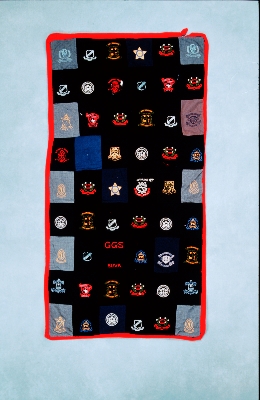
" A small rectangular quilt made from 54 embroidered badges for school blazers. Most are from NSW schools and some of these are repeated; one is for a school in Suva, Fiji. The ground fabric of the badges is wool, in shades of dark blue, light blue, black and grey. The monograms are machine and hand embroidered with school crests and mottos in Latin and English; as the embroidery is not of a finished quality, it may be that the badges were either store samples or trial pieces. The quilt is machine pieced and is backed with dark cherry red wool that turns over to the right side to form a...
History:
The Museum bought the quilt from Ros Palmer Antiques of Woollahra in 1980. The quilt is used for research and exhibition purposes only.
Related Quilts:
Repeat block in Ohio star pattern. Wide border of triangles, pieced blocks and stripes. Stars are in greens, pinks, mauves (all now very faded) and white. Wreath quilting in squares with smaller wreath quilting in triangles. There is padding and the backing is a poly/cotton sheet. 2500 x 2450mm
Quilt top with English piecing in a star in polygon pattern. English and French cotton fabrics in a wide variety of patterns and plains constructed over papers with the tacking still in tact. Papers are mainly part envelopes some with stamps and post dated 1898. 2200 x 1800mm
This domestic Wagga is two layers of woollen army blankets with the top layer in rectangles joined in rows. The backing is hessian bags that originally contained meat meal.
11650 x 1130mm
11650 x 1130mm
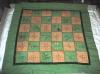
Patchwork quilt with alternate squares of green and fawn cotton headcloth. Various Australian wild flowers are embroidered in coloured threads in the green squares. In the fawn squares there is a stylised flower and leaf pattern outlined in embroidery. The border, front and back is green headcloth. The backing is printed cotton with a floral design. There is some padding.
1610 x 1610mm
1610 x 1610mm
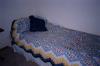
Single bed quilt made up entirely of hexagons in 'Granny's Flower Garden' pattern. The rosettes are made up of 8 hexagons and a central one. Native flower prints, including wattle, on a white background. Plain hexagons in white, yellow and blue form a scalloped border. Hexagons are hand stitched and the 2 layers are quilted in running stitch. The backing is a pieced sheet.
2400 x 1500mm
2400 x 1500mm
Quilt made from furnishing materials, mostly velour type or uncut moquette. The colours are dusty pinks and beige/camel/blue. It has been put together by making wide strips of various sized rectangles sewn together and any missing piece in a rectangle added by using another piece of material to complete the shape. There is no padding and the backing is winter cotton.
2000 x 1650mm
2000 x 1650mm