Quilt No.372FK - Fred Keen

Fred Keen
Owner: 
Fred Keen
Location: 
NSW Riverina
Maker
Maker: 
Rebecca Keen
Made in
AUSTRALIA NSW
Date: 
1921 - 1940
Description: 
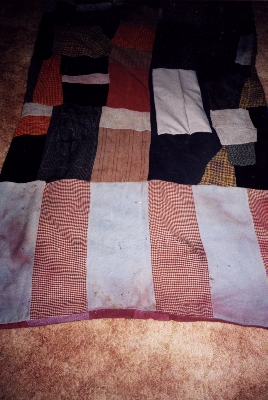
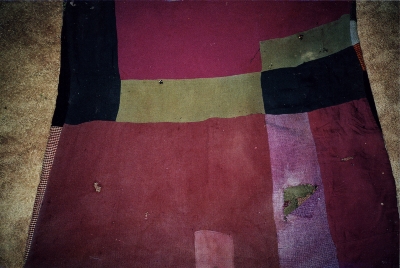
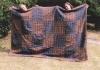
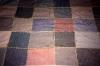
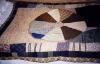
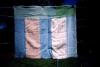
Patchwork quilt with front and back made from different sized patches of used woollen clothes, stitched in a random manner. Fabrics include men's trousers, and tweeds, checks and plains, in navy, grey, browns and fawn, and some red and white check. Backing is from larger pieces, including large patches of a dark pink, some green and some navy rectangles. Filling of wheat bags and part of a travelling rug was removed because it was too heavy.
1600 x 1000mm
History: 

Made about 1940 by Rebecca Keen (1889-1965) of Temora (NSW). Previously owned by Reg Keen, Rebecca's grandson, now owned by Fred Keen, Rebecca's son, and his wife Ena.

Story: 

"The maker of the Wagga Rug was Rebecca Keen (1889 - 1965) who was the Mother of the present owner, Fred Keen. The rug was made in about 1940. Rebecca was married to Alfred (1909) who broke his hip loading wheat and later managed pubs and grocery stores in country N.S.W. Rebecca was a Temora girl. They had 8 children and it was a tough life. Rebecca often did the cooking in the hotels they managed as well as rearing the children.
Rebecca made 6 Wagga Rugs. One was for Fred and Ena when they were 'keeping company' in the 1930s. It was a double bed size and was too heavy to use as it had wheat bags in the middle. It no longer exists. The others Rebecca made were for Fred and Ena's children i.e. her grandchildren.
This Wagga Rug was made for Reg (one of the children) about the time he was born in 1940. Reg was a bachelor and thought the world of his Wagga Rug. It used to have wheat bags and part of a travelling rug in it but these have been taken out.
Ena recalled that her Mother in law, Rebecca, would come over from Temora and do the mending and patching and make pants for her grandchildren from legs of trousers."
[Additional information from informal interview Fred Keen and Wendy Hucker for NQR, Wagga Wagga, 1999.]
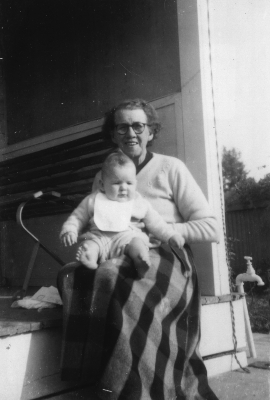
Rebecca Keen with grand son Allan, 1956

Related Quilts:

Margery Creek
Cotton quilt made in the USA. Pattern is the 'Evening Star' and each star has a frame. It is hand pieced and hand quilted and uses shirting material. It has been modified along two sides where the block extension is visible, having been turned to make a hem. The backing is calico and the padding is cotton.
1829 x 1575mm
Ida Blenkiron
Patchwork quilt of square and rectangular patches, mainly in cotton fabrics, in plains and prints. Colours are predominantly yellow, pinks, blues and prints on white. Backing is the same except there is a piece of patterned curtaining material as a patch across the middle width. Padding is old blanketing.
1830 x 1140mm
Alison Barlow
Quilt in traditional design called 'Seven Sisters'. Seven stars, each of six diamonds are set against a cream background, surrounded by bright pink triangles. Hand pieced and hand quilted. Padding is cotton, and backing is cream calico. 2100 x 1850 mm.
Fran Williams
150 x 210mm pieces of bound suiting samples overlapped and machined together then herringboned with gold/yellow thread. Each piece has an embroidered motif, using single thread, mainly non Australian birds and animals. '1903' is embroidered on a centre piece. It is hand quilted. The backing is a black floral print. There is no padding.
1800 x 1940mm
Mary Robertson
Suffolk puff quilt with each puff approximately 4cm x 4cm. The puffs are small squares rather than the more usual circles. Materials are mainly cottons and satins in a wide variety of colours and patterns. The backing is striped flannelette and is hand stitched to the top.
1660 x 1140mm
Rozanne Andrew
Quilt, single bed size, made from reused clothing roughly handstitched on to a backing of a wool/linen blanket type fabric in green, cream and brown stripes. Clothing is fronts and backs of old jumpers, vests etc as well as opened out sleeves in red, brown and grey. They are stitched together in several layers with long stitches. Another top may have been intended to cover the stitched down layers of clothing.
1500 x 1040mm