
Quilt No.402JG - Jean Gilbert
Owner:
Jean Gilbert
Location:
QLD South West
Maker
Maker:
Augusta Ruby Craigie
Made in
AUSTRALIA NSW
Patterms
Date:
1921 - 1940
Description:
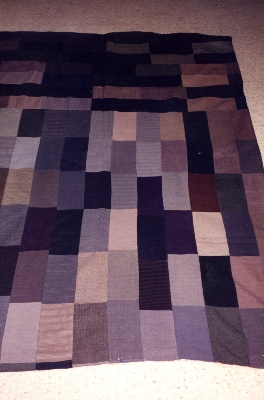
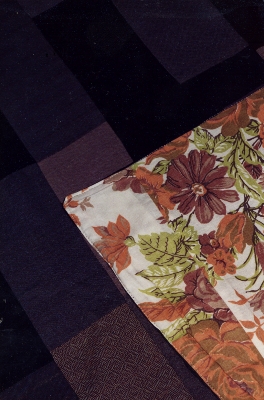
Rectangular pieces made from tailors' swatches and machine pieced in strips. Some pieces darned. Main colours blue, grey and brown. No padding. Backing is floral cotton with orange and brown flowers.
1879 x 1220mm
1879 x 1220mm
History:
The quilt was made by Augusta Ruby Craigie (born West) known as 'Gus' at Petersham Sydney in the 1930s. It was one of 11 or 12 made for the family weekender at Tuggerah Lakes (NSW). Augusta Craigie then passed it on to her grand-daughter Rhonda Graham (born Gilbert) via Jean (Bonnie) Gilbert her daughter. It is not used now.
Story:
Augusta Craigie's brother-in-law (Bert Monahan) and sister Minnie Monahan were a tailor and tailoress respectively and supplied the tailors' samples for the quilts called "wagga rugs" by the family. The weekender had six double canvas bunks and the quilts were made to use on these.
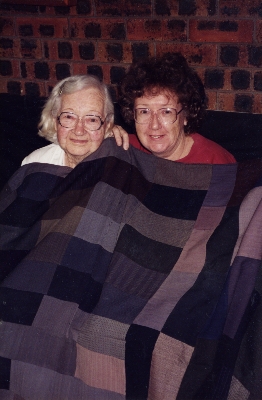
Bonnie Gilbert and Rhonda Graham
Related Quilts:
Quilt made of Suffolk Puffs or flattened circles, in different bright colours in cotton and silk. Large single bed size.
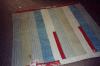
This utility quilt is mainly constructed from long strips of cotton seed sack material. It is machine pieced and quilted by hand in a diagonal pattern. There is a red border. The backing is cotton flannelette and the padding is cotton.
1601 x 1525mm
1601 x 1525mm
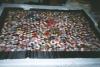
Quilt of small silk and rayon rosettes of hexagons in prints and plain materials including velvet, voided velvet, chine, printed silk, brocades, taffeta, satin, crepes. Many of the materials are from Japanese kimono and wrapping silks. It is pieced over papers, one paper has a typed date '1930'. The backing is black silk satin and is turned to the front to form a border.
1695 x 1390mm
1695 x 1390mm
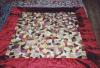
Crazy patchwork quilt of pieces of plain and patterned silks in bright and pastel colours, each patch edged and decorated with a variety of embroidery stitches, including star, spider, french knot and feather and herringbone variations. 2 patches of early aniline dyed blue silk. Motifs of tennis racquet, horse shoes, fan and some embroidered flowers. The patches are stitched to coarse linen. There is a wide border of red plush velvet turned to the underside. There is no padding. The backing is red polished cotton.
1550 x 1435mm
1550 x 1435mm
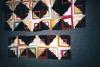
Log cabin patchwork pieces (2) with each block approximately 120 x 120mm. They are diagonally divided into light and dark side. Materials are mainly silks including silk velvets. Each block is stitched on to a backing square, pieces of old blanket, woollens, cottons, many very worn. There is no other backing.
Quilt is hand pieced.
1000 x 1000mm
Quilt is hand pieced.
1000 x 1000mm
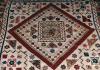
Unlined quilt. Central square of floral chintz with rectangular and chevron border making a larger frame that is set within another square-on-point frame edged with 2 toned red leaf pattererned chintz. This quilt is mainly pieced (squares, triangles, lozenges) but the hexagon rosettes are appliqued. Dress and furnishing cottons dating from the early 1800s. Raw edged, unfinished. All hand stitched.
2400 x 2400mm
2400 x 2400mm