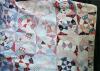
Quilt No.500RB - Rosemary Brazelis

Rosemary Brazelis
Owner: 
Rosemary Brazelis
Location: 
VIC Melbourne
Maker
Maker: 
Ellen Malkin
Made in
AUSTRALIA VIC
Date: 
1941 - 1970
Description: 
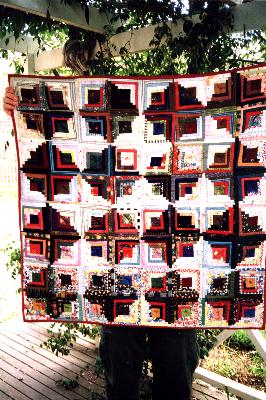
Square log cabin quilt of 16 blocks (4 x 4 rows) constructed mainly from cotton dress materials, flannels and woollens printed and plain. Machine construction (treadle sewing machine) with the pieces sewn on to cream cotton material. Later addition of polyester padding and cotton backing and the quilt tied off in each square with Perle cotton.
1030 x 1030mm
History: 

The quilt was made by Ellen Malkin between 1939 and 1945 at Underbool in the Mallee. It was then owned by Fay Bennett (born Robinson) grand-daughter of the maker and then passed on to Rosemary Lynne Brazelis (born Robinson) great grand-daughter of the maker who completed the quilt by adding a backing, padding and tying it off. It is not used.

Story: 

"Ellen Malkin nee Roe was born on the 1st August 1867 at "Bolindavale" station, Donnybrook, Victoria. She married Fredrick Malkin. They were the first settlers to select land at Underbool, North West Victoria, and grow wheat in 1910-1911.
They cleared the land of mallee scrub and lived in a tent, until they built a 4 roomed, unlined weatherboard house, with a corrugated iron roof, a kitchen and a fly-wired room at the back.
The railway line was just being laid out from Ouyen, but a camel train would bring supplies from Ouyen and carry back salt from the salt lakes (Pink lakes) out from Linga. The local store was in a tent." [Rosemary Brazelis 18.11.1999]
Ellen Malkin used dressmaking scraps, pieces given to her by friends and also materials she received by mail order from The Weekly Times. She enjoyed various crafts including sewing, tatting, knitting, crochet and mending. "She was never idle." [RB]
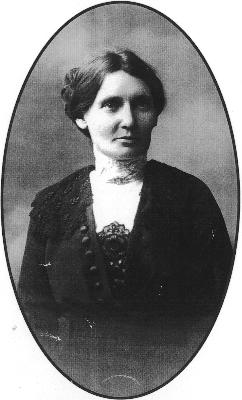
Ellen Malkin
Ellen Malkin

Related Quilts:

National Gallery of Australia
"This quilt follows the traditional hexagon patchwork pieced pattern, which are then joined and sometimes edged with a contrasting border. The edges of the quilt have been turned and then scalloped edges made of identical patches to the main body of the quilt have been attached to the edge. The quilt is fully lined, and the lining is visible front the front face through the gaps between the scalloped edge. The lining is attached to the patchwork with a row of stitches along the edges; there are no stitches in the centre field. The fabrics of the quilt are plain weave cotton in simple floral and geometric designs. Most of the fabrics are monochromatic. Several different colour ways of the same fabric are evident which could suggest some fabrics were from manufacturer samples. The lining is a William Morris print.
Each of the patchwork pieces (there are several thousand present) are sewn together with very fine overcasting stitches. The quilt is entirely hand sewn. There is some evidence that templates from the hexagon pieces possibly blotting paper, remain in situ���The quilt is not padded or quilted. The lining is fine twill weave cotton printed in pink and pale purple. The design follows William Morris's 'Strawberry Thief design'." [NGA] 2075 x 1911mm
Annette Gero
This domestic Wagga is two layers of woollen army blankets with the top layer in rectangles joined in rows. The backing is hessian bags that originally contained meat meal.
11650 x 1130mm
Doncaster-Templestowe Historical Society
Quilt made of Suffolk Puffs or flattened circles, in different bright colours in cotton and silk. Large single bed size.
The Pioneer Women's Hut
Single bed quilt made up entirely of hexagons in 'Granny's Flower Garden' pattern. The rosettes are made up of 8 hexagons and a central one. Native flower prints, including wattle, on a white background. Plain hexagons in white, yellow and blue form a scalloped border. Hexagons are hand stitched and the 2 layers are quilted in running stitch. The backing is a pieced sheet.
2400 x 1500mm
Red Cliffs Historical Society
Large hexagon rosettes in a variety of plain colours. 6 form a flower and each hexagon has a contrasting colour for the centre. Machined smaller hexagons give a ruffled effect. Colours of flowers include teal, burnt orange, pink, lime and mauve. The material is nylon and the backing is a single piece of pink bubble nylon. The padding is a single piece of calico.
2050 x 1530mm
Jindera Pioneer Museum
Quilt made of 26 x 13 rectangles of woollen men's suiting samples. Each rectangle is about 70 x 130 mm. Wide variety of patterns, mainly stripes, and colous. The padding is part of a worn cream blanket and joined pieces of woollen clothing. The backing is a well worn piece of brushed cotton. Machine made.
11900 x 1870 mm