Quilt No.478RR - Rita Ruchel

Rita Ruchel
Owner: 
Rita Ruchel
Location: 
SA
Maker
Maker: 
Toni Nickolai
Made in
AUSTRALIA SA
Date: 
1941 - 1970
Description: 
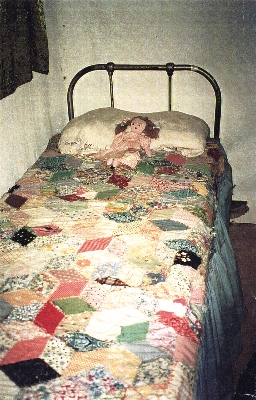
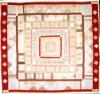
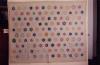
Quilt of cotton diamond shaped pieces feather stitched together with the pieces slightly overlapping. There is no padding and the backing is a light white cotton
1900 x 1060mm
History: 

Made by Toni Nickolai in the Loxton district of S.A. during WW2 and now owned by her daughter Rita Ruchel. It was used on Rita's bed when she was a teenager and then on her own daughter's bed. It is now on loan to the Willewa Community Pioneer Forest Historical Group in Meringur Vic. [1998]

Story: 

"During World War 2 it was often a struggle to make ends meet with restrictions through rationing of almost everything. There were many do-it-yourself projects. As our mother made a lot of our clothing (8 children) and her own furnishings there were many left over scraps of material. She had trained as a dressmaker before marriage. Droughts and low farming returns made it very necessary to 'make-do'. One of many Aussie battlers so all the otherwise useless pieces of material were made into something useful.
I too am a qualified dressmaker and follow the tradition of making quilts, toys etc from scraps." [Rita Ruchel 30.10.1998]
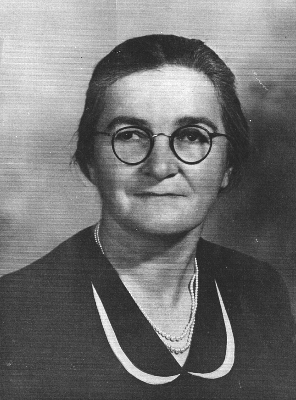
The quilt maker, Mrs. Tonie Nickolai

Related Quilts:

Mrs. F.A.C.Clemons
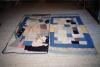
Quilt made from blocks in a fan pattern, 5 blocks across by 6 down. Fans are set on a black background, materials are wool and cotton in a mixture of plains and patterns. Edges of fans are decorated with cream herringbone stitch. Machine pieced with hand stitched repairs.Cream cotton backing folded over to make binding, stitched with pink herringbone stitch. Tied regularly with pink thread. The quilt is padded with wool.
2000 x 1720mm
National Gallery of Australia
" Reversible patchwork quilt of woollen suiting/upholstery fabrics in khaki, greys, blues and browns. Both sides have different designs. The front of the quilt has 13 rows of 12 vertical rectangles flanked on either side by a column of 22 horizontal rectangles. The reverse has a more interesting and complex design of small and very large rectangles, squares and triangles; with khaki contrasting with the duller greys and blues. The patchwork layers are joined at the edges with machine stitching and the quilt is machine quilted along 3 horizontal lines following joins in the patchwork; therefore not being totally straight. These lines are more noticeable on the reverse. The reverse face has been on display at the NGA." [NGA] There is a cotton blanket used as padding. 2054 x 1451mm
Gillian Sullivan
Quilt made of 9120 very small Suffolk Puffs, each one about the size of a 20 cent piece. "Each piece backed and the front of it drawn up like a reticule. It was not backed and was rather fragile, so I backed it on to a sheet, as it was heavy and in danger of tearing when lifted." [Gillian Sullivan]
2360 x 2230 mm
Phyllis Dowling
Hand pieced cot quilt made from small rectangular shapes of a great variety of materials including cottons, silks, wools and velvets. The backing is cotton sateen in 3 colours and is brought to the front to form a border of pink, cream and yellow.
1170 x 920mm
Euroa Historical Society
Crazy patchwork quilt with patches of velvet, satin and silk joined in 12 blocks. Each seam is embroidered and many patches have embroidered flowers. There is a 140mm maroon velvet border. The backing is maroon silk. There is a sachet that belongs with the quilt.
1800 x 1400mm
National Gallery of Australia
" A wide range of cotton fabrics have been used to make this quilt in the traditional log cabin style. The strips of the log cabin are joined by rows being hand sewn onto a small square backing fabric, each square of strips has then been hand sewn together to form the quilt. The work is backed with a sateen printed fabric decorated with paisley design. A strip of the lining trims the edge of the front face of the quilt. The lining is attached with machine stitching. There are numerous tacking stitches that remain in the front face of the quilt. There are approx 9000 pieces in the quilt, most being only 5mm in width.
The quilt is of three layers because the strips of the log cabin are attached to a backing piece, and then the quilt is lined; however it is not padded." [NGA]