
Quilt No.354JM - Jill Morrow
Description:
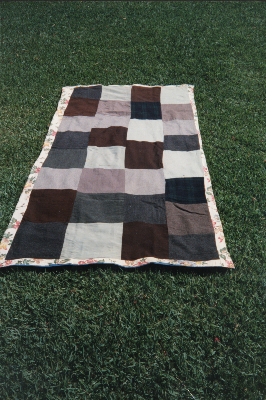
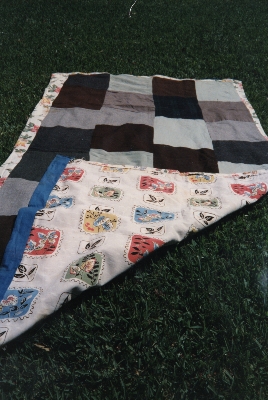
Patchwork quilt made of rectangles of twill cotton and worsted woollen fabrics, from work trousers. Colours are greys, light and dark brown, and black watch tartan in dark green and blue. Narrow border of floral print. No padding. Backing is cotton, a white background with 1950s print of rectangles of stylised foliage in red, blue and yellow. Top and bottom border of bright blue fabric.
1860 x 1000mm
1860 x 1000mm
History:
Made in the 1950s by Mary Grant at 'Myrnong', Harefield, via Junee (NSW). Previously owned by Mary Grant, now owned by Jill Morrow.
Story:
The quilt was made from Murray Grant's work trousers, and was made to cover the mattress on a cane 'day bed' on an enclosed verandah.
"Mary Grant was always resourceful and disliked waste in any form."[JM]
Related Quilts:
One side of this quilt is large pieces of check and striped material surrounding a small patterned supper cloth with a border of scrap pieces. The other side is small, floral, check, spotted, striped and plain cotton pieces surrounding a tablecloth. It is machine sewn and is not quilted. The padding is an old woollen blanket.
1825 x 1625mm
1825 x 1625mm
Scrap quilt made of vertical strips of rectangles alternating with narrow strips of pieced triangles. Colours are subdued, blues, pinks, red, browns and black, in small patterns and stripes. Fabrics are suiting, rayon, crepe, gaberdine, taffeta and blazer wool. The padding or middle layer is pieced from hessian and suiting fabric, knitted cotton. and khaki and brown twill (uniform material). The middle layer is then handsewn to the back.
1550 x 870mm
1550 x 870mm
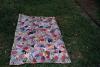
Crazy patchwork quilt with pieces made from cottons, rayons, silks and taffetas. Each piece is stuffed with kapok and machine sewn to a backing then a wholecloth floral cotton backing has been added.
920 x 164o mms
920 x 164o mms

Pieced wool quilt, machined. Rectangles and squares, from a wide variety of materials including tartans, checks, tweeds, herringbones, joined in strips and then the strips joined. The backing is scraps of woollen material with a seal motif aookiqued on. There is no padding.
1350 x 800mm
1350 x 800mm
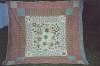
Hand pieced frame quilt with centre frame of hexagons and radiating borders of cotton and chintz. There is a heart at each of the 4 corners on the second border. It is hand quilted. There is no padding.
1900 x 1900mm
1900 x 1900mm
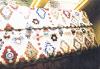
Quilt top of plain, floral and printed cotton hexagons in a diamond pattern, separated by plain white hexagons. Hand written letters have been used as templates and some are still in position but the ink is faded and the writing now illegible. Tacking stitches are still in place.
3048 x 2210mm
3048 x 2210mm