
Quilt No.40BHS - Batlow Historical Society
Owner:
Batlow Historical Society
Location:
NSW Riverina
Maker
Maker:
Unknown
Made in
ENGLAND
Patterms
Date:
1851 - 1880
Description:
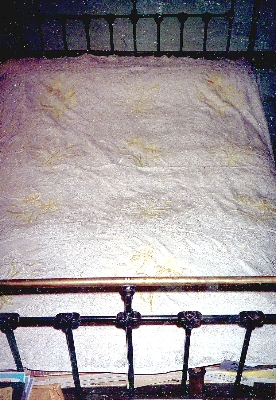
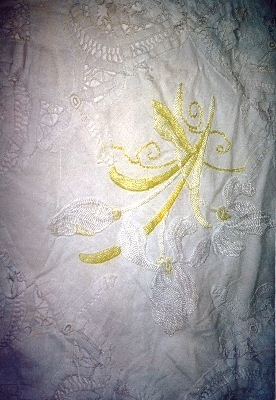
Cotton blocks set on point embroidered in satin stitch, all blocks embroidered with pattern of bearded irises in pale lemon, green, white. Alternate blocks battenburg-style cotton-lace stitched together linking blocks. Cotton torchon lace edging.
2020 x 1950mm
2020 x 1950mm
History:
Thought to have been made by Mrs Trembath/ Vingo/ Fairlie in Cornwall England about 1858. Now owned by the Batlow Historical Society.
Story:
Mrs Courtney Fairlie was married in Batlow or district in the 1920s. She came to Australia around the First World War.'Aunty Courtney' was married to Belle Foster's mother's brother David. Mrs Courtney Fairlie's mother was a Trembath. 'Aunty Courtney' married John Vingo.
[More information is available from Belle Foster in Batlow NSW]
Related Quilts:

Cotton quilt in pattern commonly known as "Double Wedding Ring'. Probably an American McCall's pattern. Hand stitched, florals, checks and plain pieces. The backing is pink cotton. Scalloped edge.
2300 x 1880mm
2300 x 1880mm
Hexagon quilt made by hand from a wide variety of cotton materials. There is no padding and the backing is calico.
2286 x 915mm
2286 x 915mm
Quuilt constructed from large pieces of used clothing pieced together to form the top. There are layers of under shirts once used by the maker's father and also by her husband Bill. The backing is an old cream blanket.
1700 x 1200mm
1700 x 1200mm
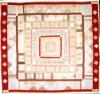
"A medallion or framed quilt in design. There is a central field of small patchwork diamonds, and from this radiates plain stripes of fabric bordering areas of patchwork panels. The edge of the quilt carries bands of red cotton, which are slightly larger at the top and bottom edges, and here the band is additionally decorated with appliqué diamonds. The fabric of the patchwork is cotton in fine plain weave of pale coloured florals and small geometric designs. The framing and border stripes are of bright red twill weave cotton. The small diamonds of the central field are hand sewn, with more use of machine stitching around the outer edge of the quilt.
The quilt is not padded. The patchwork is fully lined with a printed plain weave cotton fabric with a design commemorating Queen Victoria's Jubilee. The design is based on a repeated grid of circles. In the centre of each circle is a cameo of Queen Victoria, surrounded by images of the national flowers of England, Scotland and Ireland: the rose, the thistle and the shamrock. The edge of the front face of the quilt is trimmed with a red and white cotton braid." [NGA] 2380 x 2220mm
The quilt is not padded. The patchwork is fully lined with a printed plain weave cotton fabric with a design commemorating Queen Victoria's Jubilee. The design is based on a repeated grid of circles. In the centre of each circle is a cameo of Queen Victoria, surrounded by images of the national flowers of England, Scotland and Ireland: the rose, the thistle and the shamrock. The edge of the front face of the quilt is trimmed with a red and white cotton braid." [NGA] 2380 x 2220mm
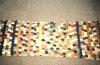
Continuous 'sleeve' of hand sewn small hexagons, many woollen, some joined, some darned, plain and patterned. Several bands of plain coloured hexagons. The padding is ticking, an old cream blanket and part of a bedspread.
1960 x 800mm
1960 x 800mm
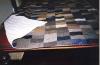
Quilt made of 26 x 13 rectangles of woollen men's suiting samples. Each rectangle is about 70 x 130 mm. Wide variety of patterns, mainly stripes, and colous. The padding is part of a worn cream blanket and joined pieces of woollen clothing. The backing is a well worn piece of brushed cotton. Machine made.
11900 x 1870 mm
11900 x 1870 mm