
Quilt No.502EHS - Euroa and District Historical Society
Description:
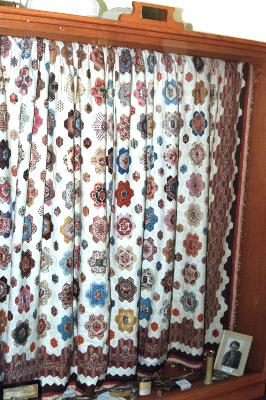
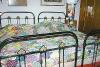
Hand stitched Grandmother's Flower Garden cotton quilt constructed from a wide variety of materials. The centre of each hexagon is a flower. On the outer edge there is a bobble fringe sewn on to a 25mm red strip. There is an inner border of a brown floral trail of hexagons. The background is white cotton.
2980 x 2880mm
2980 x 2880mm
History:
The quilt was made by the Euroa branch of the CWA to raffle in 1931. It was later donated to the Euroa and District Historical Society and displayed in the Euroa museum. In 1991, through a bequest, a purpose built cabinet was made to display the quilt.
Story:
The president of the CWA at the time was Mrs. Currie who is said to have inspired members with the idea of the quilt and taught the techniques to CWA members.
Related Quilts:
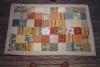
Machine sewn quilt made from 125mm squares of scraps left over from dressmaking, joined in strips and then the strips joined. There is a border of fawn cotton and the backing is the same material. The padding is an old blanket and the border is padded with sheep's wool.
1400 x 925mm
1400 x 925mm
This domestic Wagga is two layers of woollen army blankets with the top layer in rectangles joined in rows. The backing is hessian bags that originally contained meat meal.
11650 x 1130mm
11650 x 1130mm
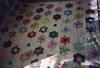
Patchwork quilt made from cotton hexagon patches in the 'grandmother's Flower Garden' pattern, in bright prints and plains, with cream 'paths' made from dress material. Padding is flannel sheeting, and backing is the same cream material as the 'paths'. The centre of the 'flower' patches are autographed with friends' names and dates, as are some 'petals' and cream patches, in black ink.
1550 x 1400mm
1550 x 1400mm

Single bed quilt made up entirely of hexagons in 'Granny's Flower Garden' pattern. The rosettes are made up of 8 hexagons and a central one. Native flower prints, including wattle, on a white background. Plain hexagons in white, yellow and blue form a scalloped border. Hexagons are hand stitched and the 2 layers are quilted in running stitch. The backing is a pieced sheet.
2400 x 1500mm
2400 x 1500mm

Quilt of machine pieced squares and rectangles using a wide variety of materials in plain colours and patterns. It is one of a pair. There is no padding and the backing is 90cm strips of calico.
2500 x 2130mm
2500 x 2130mm
Suffolk Puff quilt with puffs mainly in patterned cotton pieces saved from 60 years of household sewing. Puffs are formed into rosettes and the holes are on the top making a decorative feature. It is hand sewn.
2700 x 2400mm.
2700 x 2400mm.