Quilt No.770PHM - Powerhouse Museum

Owner: 
Powerhouse Museum
Location: 
NSW Sydney
Maker
Maker: 
Amanda Hards & May Kennedy
Made in
AUSTRALIA NSW
Date: 
1901 - 1920
Description: 
"A double bedspread composed of Suffolk puffs of fine white cotton, each puff measuring 50mm in diameter. The puffs are hand stitched together, with crochet worked in the spaces in between. A deep frill of white cotton has been added to three sides of the quilt. Two matching pillow shams have been made from 30mm puffs; each sham is edged with a generous bias cut cotton frill on all four sides." [PHM]
2770 x 2560mm
History: 

"Amanda Hards and her sister May Kennedy of Bathurst made the quilt for Amanda's son Edward (Ted) between 1910 and 1920. Amanda made the Suffolk puffs and stitched them together while May worked the crochet in the spaces between the puffs.
"The quilt was given to Edward Hards by his mother Amanda Hards and her sister May Kennedy. Edward treasured this quilt, and also a filet crochet coverlet and pillow sham made for him by May Kennedy. After Edward's death, his wife Jean Ardini of Manly Vale donated both bed covers to the Powerhouse Museum. It was her wish to keep the two quilts together." [PHM]
It is used for research and exhibition purposes only.

Story: 

"Amanda and May Kennedy were born in Campbelltown, and moved to Lambert Street, Bathurst. Not much is known about Amanda's husband except that he was a grazier in the Bathurst area; although he and Amanda did not live together he kept in touch with his son. May Kennedy had an accident during her childhood and had misshapen feet. She was once engaged, but her fiance died and she never married.
The sisters were very close and raised Edward, whom they adored, together. Amanda worked as a seamstress while May stayed at home to look after Edward. She did crochet for other people as well as working a filet crochet coverlet to her own design for Edward. Amanda's Suffolk puff quilt was said to have won a prize at the Bathurst Show, but there are no surviving records for the period. Between 1914 and 1916, Amanda consistently won first and second prizes in the underclothing sections of the Royal Easter Show.
Amanda died in 1920 when Edward was fourteen years old. His aunt May Kennedy died in the early 1940s, around the end of the war. The women were buried as requested in the same grave at Kelso. Edward changed his name from Hards to Ardini by deed poll, as he and his wife Jean were in the entertainment industry as magicians." [PHM]
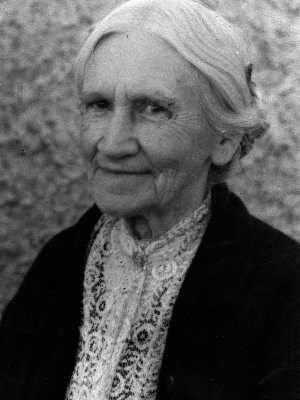
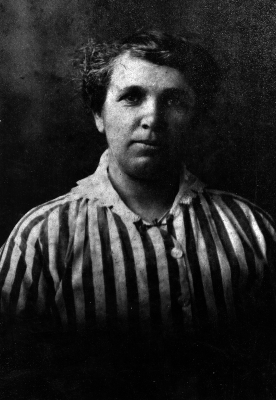
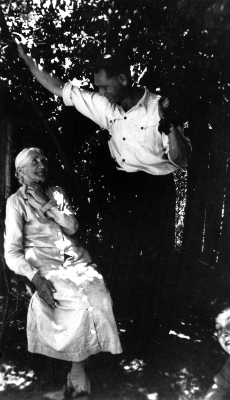
May Kennedy
May Kennedy
Amanda Hards
Amanda Hards
Edward Ardini with May Kennedy

Related Quilts:

National Gallery of Australia
" Reversible patchwork quilt of woollen suiting in grey, blue, navy, maroon and brown. The fabrics appear to be new tailor's sample pieces (the sizing is still present on the fabric, signifying it has never been washed). The patches are rectangular and vary in size. Both sides have different designs. The front of the quilt has 4 rows of 12 vertical rectangles then below this are 4 rows of 7 horizontal rectangles followed below by 4 rows of 11 vertical rectangles. The reverse of the quilt has a section at the top and bottom composed of 5 rows of 9 horizontal rectangles. The central area is made up of a centre section of 6 rows of 5 vertical rectangles; flanked on either side by a column of 10 horizontal rectangles and two columns of 8 smaller vertical rectangles.
The patchwork layers are joined at the edges with machine stitching. The patchwork layers and padding are machine quilted on the front down 2 vertical lines following joins in the patchwork; therefore not being totally straight. The lines are more noticeable on the reverse as the 2 sides do not match. The front face is displayed at the NGA.
Between the patchwork layers is a striped cotton blanket in black, sky blue, white and cream." [NGA]
2082 x 1386mm
Fran Williams
150 x 210mm pieces of bound suiting samples overlapped and machined together then herringboned with gold/yellow thread. Each piece has an embroidered motif, using single thread, mainly non Australian birds and animals. '1903' is embroidered on a centre piece. It is hand quilted. The backing is a black floral print. There is no padding.
1800 x 1940mm
Tasmanian Museum and Art Gallery
Machine sewn reversible quilt. Side 1 is rectangles of men's suiting samples in mainly grey, navy and black, stripes and self patterns. Side 2 is men's suiting samples but also includes woollen rectangular pieces in plain blue and deep pink. There is a hand sewn binding of fine orange-brown wool. The padding is hessian and cotton.
1460 x 1100mm
Ann Cuthbert
Patchwork quilt of hexagons in pattern known as 'Grandmother's flower garden'. All cotton. Rosettes are set in a white 'path' with the centre and first ring in solid colours and the second ring prints. There is a yellow border and an outer border in pink. It is hand pieced and hand quilted. The padding is cotton and the backing is white cotton with 2 border edges in light and dark blue. These borders were originally part of the top. There is an inscription "Dear daughter from Mother".
2390 x 1880mm
Rhona Dunwoodie
Block pattern consisting of a circle, hexagon and circle within a square. Cotton dressmaking fabrics with a few plain creams. Hand pieced and hand quilted. At some stage has been machine reinforced. Now faded, worn and damaged especially one end. Quilting pattern is four leaf clover inside large cable. The backing is 4 different pink toned fabrics in longitudinal stripes. Cotton batting. 2620 x 2300mm
Beryl Warne
The quilt's construction is cotton patches about 170mm square joined in strips and then the strips joined. The border and backing are pale lemon coloured cotton lawn. The padding is an old woollen blanket. There is ric-rac braid around the border of the top.
2180 x 1420mm