Quilt No.938AWM - Australian War Memorial
Australian War Memorial
Owner: 
Australian War Memorial
Location: 
ACT
Maker
Maker: 
Changi Prison Interneed
Made in
SINGAPORE Changi Prison
Date: 
1941 - 1970
Description: 
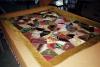
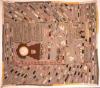
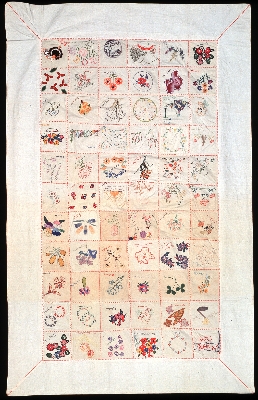
"Quilt made up of 66 embroidered squares, each 'signed' in embroidery with the maker(s) name. All the squares are edged with turkey red chain-stitch. The squares are bounded by a broad white cotton border, and the same material has been used as a backing. The back of the quilt has black embroidery stating 'Presented by the women of Changi internment camp 2602 (the number of the Japanese year corresponding with our 1942) to the wounded Nipponese soldiers with our sympathy for their suffering. It is our wish that on the cessation of hostilities that this quilt be presented to the Japanese...
History: 

This quilt is one of 2 signature quilts made by some of the 400 civilian internees in Changi Prison during the first 6 months of their captivity, from March 1942. They were made for the Australian Red Cross and the Japanese equivalent and are at the Australian War Memorial. A third quilt is held by the British Red Cross. It was hoped that the Japanese Red Cross quilt might sway their captors to send the first quilt to Australia. However the authorities returned both quilts to Colonel Collins the senior medical officer, who gave them to Colonel R.M.Webster the medical officer in charge of the Australians at the hospital at Kranji, with the request that one should go to the Australian Red Cross and the other to Colonel Webster's wife. Both were donated to the Australian War Memorial, the latter in 1968 by Mrs. Webster.

Story: 

The quilts were the idea of a Canadian internee, Mrs. Ethel Mulvaney, who had been a Red Cross representative in Singapore. Making the quilts was designed to alleviate boredom, boost morale and pass information to men in other camps. Each woman was asked to put something of herself into her square. "The quilt for the Japanese was more carefully considered and the squares, with the exception of the one made by American missionaries giving a Psalm reference, contain no messages, only scenes (mainly floral) that the makers thought would be acceptable to the Japanese���.
Two squares on this quilt have an Australian connection. Square 33, made by Helen Beck, the wife of an Englishman serving with the Malay Police (the Becks had spent a holiday in Western Australia in 1941; both were interned by the Japanese), and square 66, made by Clarice Hancock, a Eurasian girl with an Australian father."
[Australian War Memorial]

Related Quilts:
Alice Lemon
Patchwork quilt made from hexagon patches on one side, and squares and rectangles on the reverse. Cottons are used, mostly from dressmaking, in bright and light colours. The hexagons form an indented edge on all sides; on the back the rectangles have been cut at the edge to match the hexagon shapes. Hand sewn, the edge machine sewn.
No padding.
1551 x 1373mm
Nancy Dunlap
Grandmother's flower garden pattern. All cottons with plain centres to 'flowers' then row of prints and outer row of plains. One hexagon flower has been repaired. Scalloped edges bound with yellow. Hand quilting around the hexagons. The backing is cream cotton and the padding is thin cotton. 2140 x 1780mm.
National Trust of Australia (SA)
Randomly patched quilt in many different colours and fabrics. There are appliquéd shapes over many pieces including Suffolk Puffs, hearts, hexagons and other shapes. There is an embroidered inscription "A11 to S11 1829" which is thought to mean AN to SN 1829. There is no padding and the backing is white cotton.
2000 x 2200mm
Bill & Barbara Meynink
Patchwork quilt made from brightly coloured printed cotton fabrics in hexagon patches hand sewn together in rosettes, and stitched by machine onto a border of green moire taffeta. No padding. Backing is green cotton satin curtain lining. There is a matching pillow sham.
2591 x 2540mm
National Gallery of Australia
" Reversible patchwork quilt of woollen suiting/upholstery fabrics in khaki, greys, blues and browns. Both sides have different designs. The front of the quilt has 13 rows of 12 vertical rectangles flanked on either side by a column of 22 horizontal rectangles. The reverse has a more interesting and complex design of small and very large rectangles, squares and triangles; with khaki contrasting with the duller greys and blues. The patchwork layers are joined at the edges with machine stitching and the quilt is machine quilted along 3 horizontal lines following joins in the patchwork; therefore not being totally straight. These lines are more noticeable on the reverse. The reverse face has been on display at the NGA." [NGA] There is a cotton blanket used as padding. 2054 x 1451mm
Pauline Hunter
Patchwork quilt made from hexagon patches in satin and nylon, the nylon overlaid on satin. Fabrics are plain, in a mixture of dark and light colours. No padding. Backing is of pink satin with pink satin ribbon covering the joining seams. Hand sewn with some machine stitching. Feather stitching along the edge. There is no padding.
2211 x 1752mm