
Quilt No.955AP - Agnes Pratten
Owner:
Agnes Pratten
Location:
QLD South East
Maker
Maker:
Agnes Pratten
Made in
AUSTRALIA QLD
Date:
1941 - 1970
Description:
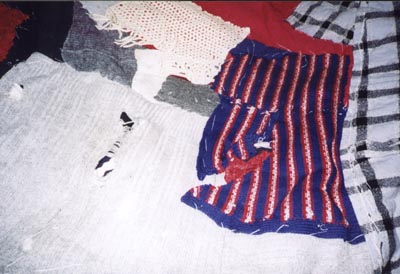
Thick padding for a wholecloth quilt constructed from pieces of old woollen clothing. The backing is a calico sheet. Originally had a cretonne cover.
History:
Agnes Pratten made 3 similar quilts for her son after WW2. Only this one now exists and in stored in the linen press and used occasionally as padding if someone sleeps on the floor.
Story:
Agnes made this quilt, and 2 others, for her son when he flatted with his mates. When the mates moved on they took 2 of the quilts with them. This one survived because it was so heavy. It was stored in the shed and only used by her son on camping trips.
Related Quilts:
Wholecloth pram quilt with a top of pink cotton sateen, and the reverse is a more finely woven, ivory, fabric. All over quilting design as main feature, with stylised hearts, leaves and cross hatching. The padding is cotton batting. 870 x 660 mm.
Hand stitched, cotton, appliquéd, quilt in a flower pattern on a plain background. Colours are shades of green, apricot and browns. This quilt was known as a 'Bride's Quilt'. Padding is thought to be layers of white fabric raised almost like a wadding. The backing is cotton material. 2470 x 2020 mm.
Quilt remnant. This piece of the top is hand embroidered in gold thread on a background of burgundy silk in a traditional style still practised by Greek women today. The backing is white and probably cotton or linen.
940 x 430mm
940 x 430mm
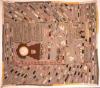
"This is a coverlet of pale blue cotton muslin, highly decorated with appliquéd pieced bands, figures, and embroidery. The edge of the quilt is finished with bands of yellow, white and green cotton attached with ladder stitch.
Down the centre field of the design and 4 poems embroidered in quite crude chain stitch. Each piece of prose is accompanied by an appliquéd illustration. For example a large clock accompanies a poem of time. 'While shepherds watch their flocks at night�.'is illustrated with a beautiful scene of the manger watched by an angel, cows and sheep. The appliqué and embroidery is executed crudely with large stitches in running and overcasting. The quilt is signed, 'M.J.H. aged 84 yrs.1924.' " [NGA] There is no padding or lining. 1640 x 1540mm
Down the centre field of the design and 4 poems embroidered in quite crude chain stitch. Each piece of prose is accompanied by an appliquéd illustration. For example a large clock accompanies a poem of time. 'While shepherds watch their flocks at night�.'is illustrated with a beautiful scene of the manger watched by an angel, cows and sheep. The appliqué and embroidery is executed crudely with large stitches in running and overcasting. The quilt is signed, 'M.J.H. aged 84 yrs.1924.' " [NGA] There is no padding or lining. 1640 x 1540mm
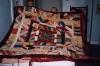
Patchwork quilt of multi coloured silks and brocades. Crazy patchwork borders, mainly rectangular fabrics pieced together in diagonal patterns, radiating from a central frame embroidered with flowers. Many pieces are extensively embroidered in a great variety of stitches and motifs; butterflies, sunflowers, cats, daffodils, crown, pawn broker's symbol, 'money to lend', 'good night', the initials of family members and 'mater 1890'. The quilt has a deep border of maroon sateen. There is no padding visible but it is possibly a blanket. The backing is green/gold silk with a self stripe with red cotton damask showing underneath, possibly an earlier backing.
2165 x 2165mm
2165 x 2165mm
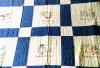
Patchwork quilt made for a child. All cotton with cotton padding. White blocks have embroidery depicting different nursery rhymes eg Mary, Mary, Quite Contrary ; Old Mother Goose. These blocks are separated by rectangular strips of teal cotton. The quilt is hand stitched and heavily quilted.
1677 x 1271mm
1677 x 1271mm