
Quilt No.993SJ - Shari Jamieson
Owner:
Shari Jamieson
Location:
WA Perth
Maker
Maker:
Lenore Myrtle Howes
Made in
USA Nebraska
Patterms
Date:
1921 - 1940
Description:
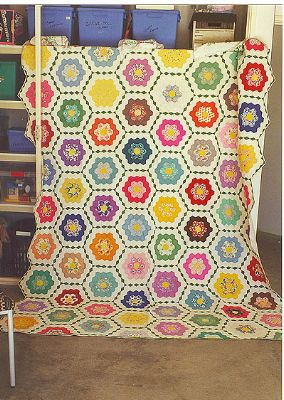
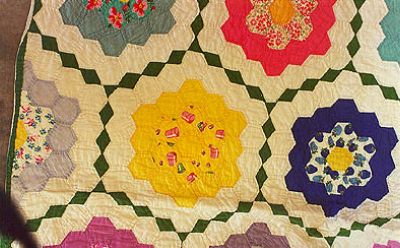
Pieced repeat block in hexagons, hand pieced and hand quilted. The pattern is sometimes called 'Grandmother's Garden'. Hexagons are a combination of plain and printed cottons, with a background of cream hexagons, outlined with green diamonds. Padding is cotton batting and the backing is white homespun. 2500 x 2030 mm.
History:
Quilt was made by Lenore Myrtle Howes (born Silvies, 1913 - 99) in North Platte, Nebraska, USA; probably in the 1930's. It was then owned by her daughter, Sandra Lee Mires James, and now by her granddaughter, the present owner. It is not used.
Story:
"I remember this quilt as always being in my childhood home. As children in the late 60's, early 70's my sister and I love playing 'Barbies' on it. My grandmother once remarked of the 'thousands' of pieces on it." [Shari Jamieson]
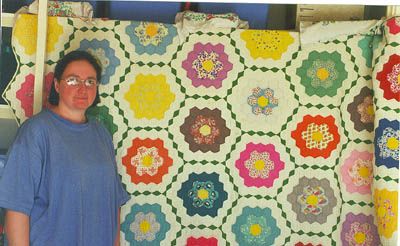
Shari Jamieson with her quilt.
Related Quilts:
Unfinished patchwork top made from hexagon patches in the 'Grandmother's Flower Garden' pattern, in glazed and unglazed cottons and some twill fabrics. 7 patches for flowers with white and some cream patches forming paths. All fabrics are patterned and date from c.1825-1840, including pieces of toile de jouy, stripes and florals. Colours are predominantly reds and blues with some green, brown, purple; one flower is in chrome yellow, 8 flowers are in turkey red indicating probably the latest fabric. The quilt is hand sewn and the papers are in tact in most patches.
1508 x 940mm
1508 x 940mm
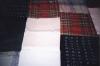
Double sided patchwork quilt/rug. Mainly squares machined together in strips (8 across). Average square 22 to 24cms. One side has a large piece of dark grey woollen material. The materials for the squares include tweed, mohair,many woollens, tartans and cream blanketing all of which were scraps or from used clothing.
1820 x 1680mm
1820 x 1680mm
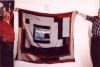
Double sided frame quilt. All reused materials including corduroys, wools and light weight suitings. Machine made and not quilted There is no padding as already heavy and warm.
1780 x 1530mm
1780 x 1530mm
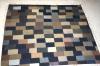
Quilt of woollen rectangles, probably tailors' samples. Machine pieced. The backing is floral cotton similar to curtain material.The backing has a french seam down the centre back and is folded over to the front to form a binding. There is no padding.
1440 x 1260
1440 x 1260
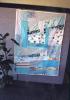
Machine pieced cotton quilt, in random design of geometric pieces. Materials used are cotton sheeting, dress fabrics, broderie anglaise, and seersucker. There is no padding, and backing is white curtain lining.
1540 x 1150 mm.
1540 x 1150 mm.
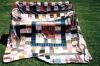
Rectangular quilt of print and plain
cottons pieced in squares and rectangles within 2 frames, the inner border or frame of blue/green check material, then 2 rows of squares and rectangles, the outer frame of a grey and red geometric pattern and 2 rows of squares or rectangles. Backing of plain fabric. Machine stitched on a treadle machine.
cottons pieced in squares and rectangles within 2 frames, the inner border or frame of blue/green check material, then 2 rows of squares and rectangles, the outer frame of a grey and red geometric pattern and 2 rows of squares or rectangles. Backing of plain fabric. Machine stitched on a treadle machine.