Quilt No.372FK - Fred Keen

Fred Keen
Owner: 
Fred Keen
Location: 
NSW Riverina
Maker
Maker: 
Rebecca Keen
Made in
AUSTRALIA NSW
Date: 
1921 - 1940
Description: 
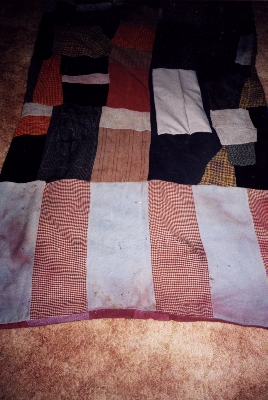
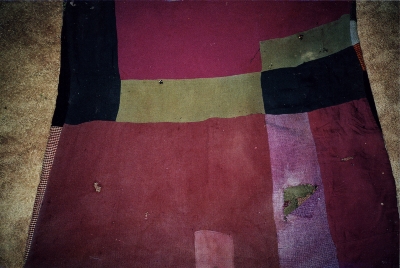
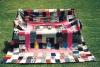
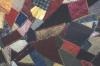
Patchwork quilt with front and back made from different sized patches of used woollen clothes, stitched in a random manner. Fabrics include men's trousers, and tweeds, checks and plains, in navy, grey, browns and fawn, and some red and white check. Backing is from larger pieces, including large patches of a dark pink, some green and some navy rectangles. Filling of wheat bags and part of a travelling rug was removed because it was too heavy.
1600 x 1000mm
History: 

Made about 1940 by Rebecca Keen (1889-1965) of Temora (NSW). Previously owned by Reg Keen, Rebecca's grandson, now owned by Fred Keen, Rebecca's son, and his wife Ena.

Story: 

"The maker of the Wagga Rug was Rebecca Keen (1889 - 1965) who was the Mother of the present owner, Fred Keen. The rug was made in about 1940. Rebecca was married to Alfred (1909) who broke his hip loading wheat and later managed pubs and grocery stores in country N.S.W. Rebecca was a Temora girl. They had 8 children and it was a tough life. Rebecca often did the cooking in the hotels they managed as well as rearing the children.
Rebecca made 6 Wagga Rugs. One was for Fred and Ena when they were 'keeping company' in the 1930s. It was a double bed size and was too heavy to use as it had wheat bags in the middle. It no longer exists. The others Rebecca made were for Fred and Ena's children i.e. her grandchildren.
This Wagga Rug was made for Reg (one of the children) about the time he was born in 1940. Reg was a bachelor and thought the world of his Wagga Rug. It used to have wheat bags and part of a travelling rug in it but these have been taken out.
Ena recalled that her Mother in law, Rebecca, would come over from Temora and do the mending and patching and make pants for her grandchildren from legs of trousers."
[Additional information from informal interview Fred Keen and Wendy Hucker for NQR, Wagga Wagga, 1999.]
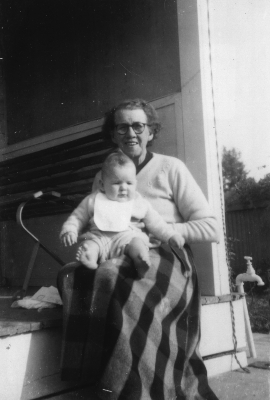
Rebecca Keen with grand son Allan, 1956

Related Quilts:

Margaret McMillan
Cotton log cabin double bed quilt. Each square has 52 pieces (i.e. 13 pieces x 4 to make a square). There are 192 squares so a total of 10.092 pieces. There is probably no padding. The backing is calico with a floral pattern done in running stitch.
2200 x 2200mm
Robert O'Hara Burke Memorial Museum
Miniature crazy quilt either for a baby or a doll. Plain and patterned materials including velvet, satin, sateen and brocade. 4 patches are embroidered and the central patch has a hand painted flower. Each patch is embroidered around the edge with a variation of feather stitch. It has a brown binding and lace edge. The backing is twill cotton.
490 x 390mm
June Johnson
Hand sewn cotton cot quilt with pattern of red and white lozenge shaped hexagons measuring approximately 65mm from top to bottom. A centre flower is constructed from 2 circles of 19 hexagons in red and white. This is surrounded by 8 smaller hexagon flowers. Additional single red hexagons are scattered at random on the white background around the rows of flowers. The quilt is not quilted or tied but is attached at all 4 edges. Writing on the back of the quilt (probably added later) reads "Made by Sarah Hodge, Newport, Wales UK for her first child John." There is no padding and the backing is white cotton. 1000 x 1250 mm.
Eileen Dinning
Double sided silk quilt. One side is paisley designs and the reverse plain silk . Machine pieced. There is a thin padding possibly sheeting.
2694 x 2287mm
Port Curtis Historical Soc.Inc.
Cotton Hexagon quilt with a wide variety of patterned and plain materials. Blue binding and a cotton backing. The padding is thought to be cotton wool.
1525 x 1220mm
National Gallery of Australia
" Reversible patchwork quilt of woollen suiting/upholstery fabrics in khaki, greys, blues and browns. Both sides have different designs. The front of the quilt has 13 rows of 12 vertical rectangles flanked on either side by a column of 22 horizontal rectangles. The reverse has a more interesting and complex design of small and very large rectangles, squares and triangles; with khaki contrasting with the duller greys and blues. The patchwork layers are joined at the edges with machine stitching and the quilt is machine quilted along 3 horizontal lines following joins in the patchwork; therefore not being totally straight. These lines are more noticeable on the reverse. The reverse face has been on display at the NGA." [NGA] There is a cotton blanket used as padding. 2054 x 1451mm