
Quilt No.648NG - Norma Gilchrist

Description:
Quilt entirely made of hexagons joined to make 'flowers', 6 hexagons form the petals and one in the centre. The quilt is all cotton in a wide variety of colours in plains, checks and florals. The hexagons are all hand stitched using stranded cotton. There is a plain blue border of headcloth machined around the edge to the backing material. It is not quilted The materials were almost all from the scrap bag. Brown paper templates were used. This arrangement of hexagons is one variation of a pattern commonly called 'Grandmother's Flower Garden'.
2040 x 1720mm
2040 x 1720mm
History:
The quilt was made by Sylvia Schliebs and her daughter Norma in the Temora district NSW c.1845. It is now owned by Norma (Gilchrist). It is still used.
Story:
Sylvia Schliebs (1898-1995) and her daughter Norma sewed this quilt in the wintertime after tea at night. They lived on a mixed farm, 'Spring Valley', and Sylvia's life was like that of many farmers' wives with farm jobs to do including milking cows and looking after many chooks. She sold butter and eggs and bunches of violets and made most of her own and Norma's clothes. She was thrifty, practical and a good cook.

Sylvia Violet Schliebs c.1946
Related Quilts:
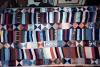
Scrap quilt made of vertical strips of rectangles alternating with narrow strips of pieced triangles. Colours are subdued, blues, pinks, red, browns and black, in small patterns and stripes. Fabrics are suiting, rayon, crepe, gaberdine, taffeta and blazer wool. The padding or middle layer is pieced from hessian and suiting fabric, knitted cotton. and khaki and brown twill (uniform material). The middle layer is then handsewn to the back.
1550 x 870mm
1550 x 870mm

Pieced wool quilt, machined. Rectangles and squares, from a wide variety of materials including tartans, checks, tweeds, herringbones, joined in strips and then the strips joined. The backing is scraps of woollen material with a seal motif aookiqued on. There is no padding.
1350 x 800mm
1350 x 800mm
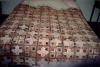
Cotton log cabin double bed quilt. Each square has 52 pieces (i.e. 13 pieces x 4 to make a square). There are 192 squares so a total of 10.092 pieces. There is probably no padding. The backing is calico with a floral pattern done in running stitch.
2200 x 2200mm
2200 x 2200mm
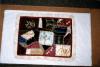
Miniature crazy quilt either for a baby or a doll. Plain and patterned materials including velvet, satin, sateen and brocade. 4 patches are embroidered and the central patch has a hand painted flower. Each patch is embroidered around the edge with a variation of feather stitch. It has a brown binding and lace edge. The backing is twill cotton.
490 x 390mm
490 x 390mm
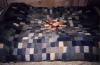
Large double sided quilt of rectangles and squares of men's suitings, patterned and plain on both sides. The top has a central motif of a circle of three segmented rings radiating from a single hexagon. The outer ring is all tailors' samples and the inner rings are a variety of materials. There is some featherstitching in red. The quilt is sparsley machine quilted.
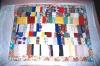
Utility patchwork quilt made up of mainly squares of furnishing material machine pieced. It is backed with machine pieced patches of woollen jumpers, mainly machine not hand knitted. The back is possibly the top. There is no padding.
1950 x 1270mm
1950 x 1270mm