
Quilt No.926ESA - The Embroiderers' Guild of S.A.Inc Museum
Owner:
The Embroiderers' Guild of S.A.Inc Museum
Location:
SA Adelaide
Maker
Maker:
Anna Blackmore
Made in
ENGLAND
Date:
pre 1850
Description:
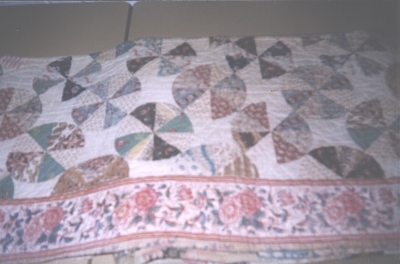
4 Pieces of a patchwork quilt which was formerly a whole quilt. It is pieced in cottons in blues reds and browns in many prints. There are whole circles and pieced circles against a plain cream calico background. It is wool lined and is quilted. There are the initials 'A.B.' and '1828' on a central piece. The 4 pieces are various sizes.
History:
The quilt was made by Anna Blackmore in England and thought to have been started c.1828 and taken many years to complete. It was later owned by Miss Eva Tazewell who received it from her father George who was related to Miss Blackmore. George received it after he emigrated to Australia from Somerset. It was donated to the Embroiderers' Guild of SA.
Story:
Anna Blackmore was the sister of Robert Blackmore who wrote 'Lorna Doone'. Eva Tazewell was state hockey coach in the 1940s.
Related Quilts:
Wholecloth pram quilt with a top of pink cotton sateen, and the reverse is a more finely woven, ivory, fabric. All over quilting design as main feature, with stylised hearts, leaves and cross hatching. The padding is cotton batting. 870 x 660 mm.
Hand stitched, cotton, appliquéd, quilt in a flower pattern on a plain background. Colours are shades of green, apricot and browns. This quilt was known as a 'Bride's Quilt'. Padding is thought to be layers of white fabric raised almost like a wadding. The backing is cotton material. 2470 x 2020 mm.
Wholecloth quilt made of red floral crinoline cotton material. Quilting is in vertical rows, alternating cables with orange peel patterns. Padding is of cotton flock. Backing is of white cotton. Quilt is edged with a self fabric ruffle on three sides. Hand sewn.
2236 x 2236mm
2236 x 2236mm
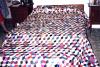
Tumbling Block quilt made from pure silk ribbons, patterned and plain. The quilt edge follows the block shapes. The backing is polished cotton printed with flowers.
2743 x 2439mm
2743 x 2439mm
Patchwork quilt made from squares and rectangles of pink, blue and white fabric set with a frame of pink and white print around a centre rectangle made of 4 pink triangles. Four corner squares of blue and white stripes, Many squares are pieced from smaller scraps. The Material is a crepe type, possibly used for underwear. Handsewn and machined. Backing is made from cotton scraps, possibly lawn or similar. Padding is flanellete or similar. Edges are bound in a striped material. Quilt shows signs of wear.
620mm x 520mm
620mm x 520mm
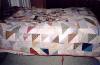
Double sided quilt. Side 1 has a central patch of small rectangles and borders of half square triangles. Seamed construction. Side 2 is crazy patch in wools and cottons on to a backing material. There is one round segmented circle in the centre. Machine pieced and quilted.
2050 x 1610mm
2050 x 1610mm